
For many owners of privately held companies, the biggest tax bill of their lives arrives on the day they sell. Where they are legally resident when it does can be worth millions of dollars, and a growing number of owners are acting on that.
Quick Summary
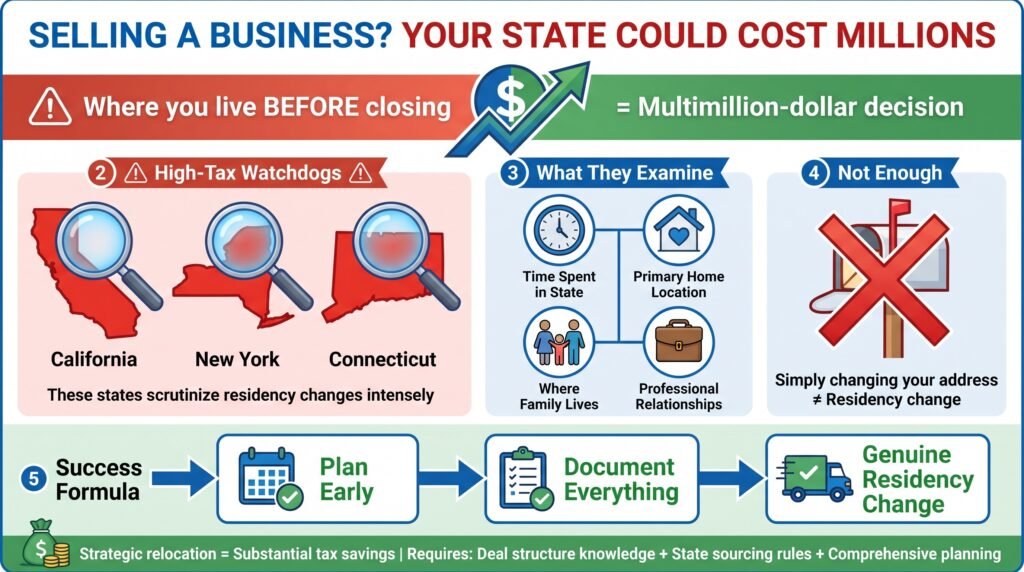
Selling a business can trigger a significant state tax liability, making where you live before the transaction closes a potentially multimillion-dollar decision. Establishing residency in a lower-tax state before a sale may reduce the tax burden, but simply changing your address is not enough.
States such as California, New York, and Connecticut closely scrutinize residency changes, examining everything from where you spend your time to where your family, home, and professional relationships are located.
The key is to plan early, understand how the deal is structured, and account for state-specific income sourcing rules. Relocation can create substantial savings, but only when supported by genuine residency changes, careful documentation, and comprehensive tax planning.
Table of Contents
- Quick Summary
- Why the Business Sale Is the Moment That Matters
- The Residency Trap
- Deal Structure and the SALT Cap
- It Isn’t Only Income Tax
- Practical Takeaways for Owners
- How to Choose the Right Business Broker for Your Exit
- The Bottom Line
- Frequently Asked Questions

Why the Business Sale Is the Moment That Matters
Business owners tend to be less sensitive to state taxes during their working years than they are at exit, and the reason is structural. Ongoing income from an operating business is spread across years, and much of it is reinvested. A sale compresses a lifetime of accumulated value into one tax year.
State rates that feel tolerable when applied to annual profit suddenly look enormous when applied to a seven- or eight-figure gain.
This is why the advice from sale advisors tends to center on timing. If an owner was already planning to retire to a warmer climate, to be near grandchildren, or to downsize, moving before the transaction closes, rather than after, can change the outcome dramatically.
Several advisory firms make this point directly: owners who intend to relocate anyway should treat the order of operations as a major financial decision, not a lifestyle detail.
The approach is not new. What has changed is the number of owners approaching retirement age, the size of recent deal values, and the fact that remote work has loosened the tie between where a business operates and where its owner sleeps.
A founder whose company is run by a management team no longer needs to live within driving distance of headquarters.

The Residency Trap
If moving before a sale were as simple as renting an apartment in Miami, every owner would do it. It is not, and the states that stand to lose the most revenue are the most aggressive about challenging claims of new residency.
Domicile is about intent and facts, not paperwork. High-tax states such as California, New York, and Connecticut closely scrutinize taxpayers who change residency shortly before a large taxable event.
Auditors look at where the person spends their days, where their family lives, where their doctors and accountants are, where their valuables are kept, which home is larger, and even where they renewed their driver’s license.
A person who declares Florida residency while the spouse and children remain in the old family home, and who keeps working from the old office, is inviting a challenge. Advisors say the best defense is a documented paper trail built from the first day of the move.
Timing alone does not work
Tax professionals warn that selling a business the day before claiming to move will not persuade the old state that the gain belongs to the new one.
Advisors who focus on this area often recommend moving well in advance, in some cases years before a sale, so that the change of domicile is established and credible.
Some income stays with the old state regardless.
Residency determines who can tax all of your income. It does not stop a state from taxing income sourced within its borders.
According to guidance from the accounting firm Wipfli, when owners sell business assets rather than ownership interests, a structure buyers often prefer because it allows depreciation deductions, the seller can owe tax to every state where the income is sourced.
Real estate, operating assets, and certain passive income streams tied to a high-tax state can remain taxable there even after the owner has left.
These rules mean that a move can fail in two ways. An owner can lose a residency audit and owe the full tax plus penalties and interest. Or an owner can establish residency successfully but discover that a large part of the gain was sourced to the state they left, so the savings are smaller than projected.
Deal Structure and the SALT Cap
The federal tax code adds another layer. Since 2017, the deduction for state and local taxes paid has been capped, which meant that a high-tax-state owner could not fully deduct the very taxes that made leaving attractive. For 2026, the cap was raised under recent legislation, but the increase is temporary and phases out for higher earners.

One advisory summary notes that taxpayers with incomes above roughly $600,000 are effectively back to a $10,000 cap, which includes most sellers of businesses worth many millions.
Many owners of pass-through businesses, such as LLCs and S corporations, use pass-through entity tax elections to work around the cap. These elections allow the business to pay state income tax at the entity level, which can then be deducted federally.
Advisors say the technique is most useful where state liabilities are well above the cap. It does not eliminate the underlying state tax, however, and it does nothing for an owner whose main concern is the size of the state rate itself.
Owners with qualifying stock may also look at the qualified small business stock exclusion, which can shield a significant part of a gain from federal tax, and sellers can consider installment sales to spread recognition of gains over several years.
Each technique interacts differently with state residency rules, which is one reason sale planning is rarely a do-it-yourself project.
It Isn’t Only Income Tax
A low-income-tax state is not a low-tax state in every respect. Financial advisors caution that jurisdictions raise revenue through many channels, including property taxes, sales and use taxes, franchise taxes, local levies, inheritance taxes, and business fees.
A state with no income tax may compensate with higher property or sales taxes. For an owner whose primary expenses are a large home and substantial spending, the net effect may be smaller than the headline suggests.
Non-tax factors also matter. Business-climate rankings, such as CNBC’s annual list of top states for business, weigh workforce, infrastructure, regulation, and cost of living, and a state can offer a low tax rate while ranking poorly overall.
Family ties, health care access, and community often outweigh a calculation on a spreadsheet, and owners who move purely for taxes sometimes report that the savings did not compensate for what they gave up.

Practical Takeaways for Owners
Owners considering a move before a sale should keep a few principles in mind. Start early; relocation planned years before a transaction is more credible than one planned months before. Move your life, not just your address, including your family, primary home, professional relationships, and daily routines.
Understand how the sale is structured, because asset sales and equity sales can produce very different state-sourcing outcomes. Model the whole picture, including property, sales, and estate taxes, not only the income tax rate. And work with a tax advisor experienced in residency audits, since the old state is likely to look closely.
Owners should also remember that the departing state is often not out of the picture. Documentation matters, but so does consistency: the story told to the tax authority must match how the owner actually lives.

How to Choose the Right Business Broker for Your Exit
Matching Broker Expertise to Your Business Size ($1M-$40M)
Business size represents a crucial matching factor when selecting an appropriate broker representation.
Small businesses valued under $1 million typically require different marketing approaches and buyer networks than mid-market companies valued between $5-40 million. The most effective brokers specialize within specific valuation ranges rather than attempting to serve all market segments equally.

Earned Exits has developed particular expertise with businesses valued between $1-50+ million, with specific methodologies tailored to different valuation segments within this range.
Their approach recognizes that a $2 million service business requires different positioning and buyer targeting strategies than a $30 million manufacturing operation, even while applying consistent transactional excellence principles across all engagements.
Earned Exits has facilitated over 47 successful business transactions worth $2.1 billion, demonstrating how specialized industry knowledge translates to exceptional results.
While many brokers operate as generalists, Earned Exits has developed specialized expertise across 17 distinct business sectors, including manufacturing, distribution, professional services, technology, and specialty contracting.
This preparation phase frequently generates the highest return on investment in the entire exit process, with strategic improvements often increasing final transaction values by 20-50% when implemented 12-24 months before planned exits. Start the process of your business exit today with Earned Exits free business valuation by clicking the button below:



Earned Exits Testimonials


The Bottom Line
State taxation is now an ordinary part of the exit conversation for owners of closely held businesses, and in some cases it is the deciding factor in where an owner chooses to live when a sale closes.
The strategy works best for owners who have a real reason to move, can do so well ahead of time, and are prepared for scrutiny. It works poorly as a last-minute maneuver.
At the policy level, the picture is contested. States that raise taxes on high earners and business gains argue the departures are too small to matter and that the revenue funds services owners rely on.
States and advocates favoring lower taxes argue that mobile capital and entrepreneurs will keep finding the door. The evidence leans toward modest aggregate effects with large effects for the right individual at the right moment, which is exactly why a business sale remains the single event most likely to turn state tax policy into a personal decision.
Learn more about why the exit that costs more in some zip codes than others, the Washington case study, and much more in this article here.
Frequently Asked Questions
These common questions address the concerns most business owners face when contemplating their exit strategy. While each situation presents unique considerations, these general guidelines provide starting points for your exit planning discussions.
1. Can moving to a no-income-tax state before selling my business reduce my taxes?
Yes. Establishing residency in a state with no individual income tax before a business sale may significantly reduce state income taxes on the gain. However, the move must be genuine, properly documented, and completed before the taxable transaction.
2. How long before selling should I establish residency in another state?
There is no universal timeframe. However, tax advisors often recommend relocating well in advance, potentially years before a sale, to establish a credible change in domicile and reduce the risk of a residency audit.
3. How do states determine where I actually live for tax purposes?
States examine more than your mailing address or driver’s license. They may consider where you spend your time, where your spouse and children live, which home is your primary residence, where you maintain professional relationships, and where your personal belongings are kept.
4. Can my former state still tax the proceeds after I move?
Yes. Even after successfully establishing residency elsewhere, your former state may tax income sourced within its borders.
This is particularly important in asset sales, where business assets and operations located in multiple states can create state tax liabilities.
5. Does the structure of my business sale affect state taxes?
Absolutely. Asset sales and equity sales can have very different state tax consequences.
The allocation of sale proceeds, location of business assets, and nature of the income can all affect how much each state can tax.
6. Are there other tax strategies business owners should consider?
Yes. Depending on eligibility and circumstances, owners may benefit from pass-through entity tax elections, the qualified small business stock (QSBS) exclusion, or installment sales.
Each strategy has different federal and state tax implications.
7. Is moving to a state with no income tax always the best financial decision?
Not necessarily. Property taxes, sales taxes, estate taxes, business fees, cost of living, and family considerations can offset some of the potential savings.
Owners should evaluate their total financial picture rather than focus exclusively on income tax rates.
8. What is the biggest mistake business owners make when relocating before a sale?
Waiting until the last minute or treating residency as a paperwork exercise. A successful relocation requires a genuine change in lifestyle, consistent documentation, and planning well before the business transaction closes.

*Disclaimer: This article is written for educational purposes and should not be interpreted as financial advice.
*Disclaimer: This article is written for educational purposes and should not be interpreted as financial advice. We may receive compensation for referrals made through this article.