
Key Takeaways
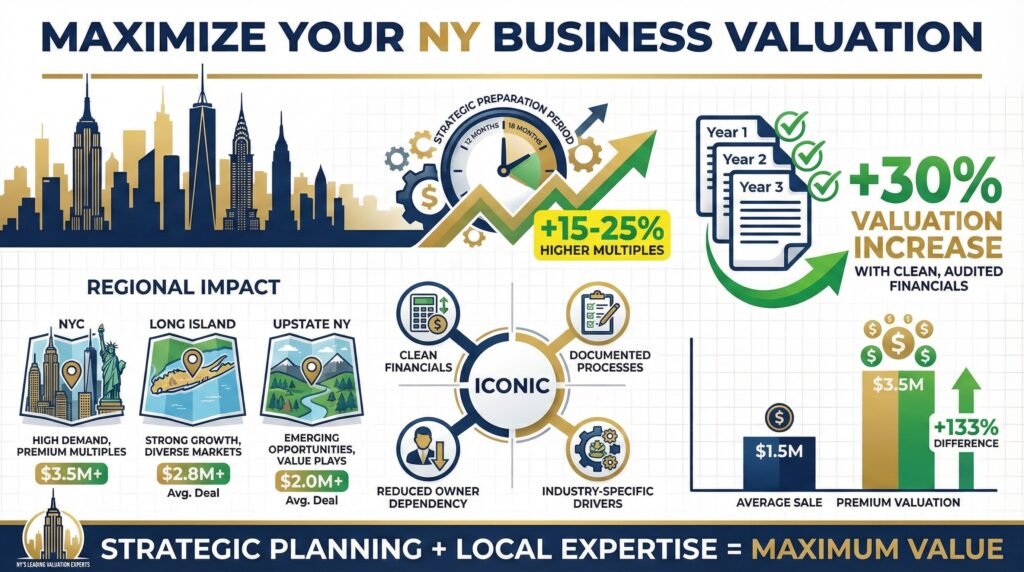
New York businesses sell for 15-30% higher multiples when strategic value-building measures are implemented 12-18 months before listing
Location-specific factors in NYC, Long Island, and Upstate regions dramatically impact valuation metrics and buyer expectations
Clean financial records with 3+ years of normalized statements can increase business valuation by up to 30% in competitive NY markets
Iconic, the leading NY business valuation firm, helps owners identify often-overlooked value drivers specific to their industry
Businesses with documented operational processes and reduced owner dependency command premium prices in the current New York market
Selling a New York business requires strategic planning, precise timing, and local market expertise. The difference between an average sale and a premium valuation often comes down to preparation and understanding the unique dynamics of the Empire State’s business landscape.
With the right approach, you can significantly increase your business’s value before entering the competitive New York market.
3 Critical Facts About New York Business Valuation That Sellers Miss
The New York business market operates by its own rules. Understanding these nuances can mean the difference between leaving money on the table and maximizing your exit value. Most business owners underestimate how dramatically local market conditions influence buyer behavior and valuation standards.
Many sellers make the critical mistake of applying national valuation averages to their New York business. This oversight can cost you significantly, as New York businesses often command higher multiples due to the state’s economic strength, diverse customer base, and strategic location advantages. Local market knowledge is essential for accurate valuation in this complex environment.
Buyers in the New York market have specific expectations regarding financial documentation, growth potential, and business infrastructure that differ from those in other regions. Meeting these expectations before listing can dramatically increase your business’s appeal and value proposition.
Why Timing Matters More in New York Than Anywhere Else
New York’s business market experiences distinctive seasonal fluctuations that can significantly impact your valuation and buyer pool. Historically, businesses listed between February and June receive the highest number of inquiries and most competitive offers, while the November-January period typically sees reduced buyer activity.
This timing factor becomes even more pronounced in retail, hospitality, and seasonal businesses where demonstrating full-year performance cycles is crucial for maximum valuation.
The Real Impact of Location on Your Business Value
Location value within New York varies dramatically between regions, with significant implications for your valuation strategy. Manhattan businesses typically command 1.5-2x higher multiples than comparable businesses in upstate regions, while Brooklyn and Queens are seeing rapidly appreciating business values as these boroughs experience commercial revitalization.
Understanding your location’s specific advantages – whether it’s foot traffic in SoHo, manufacturing access in Buffalo, or tourism draw in the Hudson Valley – allows you to highlight these assets during valuation discussions and marketing materials.
Beyond the obvious address factors, buyers are increasingly focused on lease terms, zoning flexibility, and future development plans in surrounding areas. Businesses with favorable long-term leases or owned real estate in growth corridors can command significant premiums over those with uncertain occupancy futures or challenging locations.
Industry-Specific Multiples Currently Dominating the Market
New York’s business valuation landscape varies dramatically by industry, with current multiples reflecting both economic trends and buyer preferences. Technology and healthcare businesses in New York are currently commanding premium multiples (often 6-8x EBITDA), while retail and traditional manufacturing typically range from 2-5x EBITDA depending on location and growth trajectory.
Industry trends become even more specialized within New York’s distinctive ecosystem. For example, food manufacturing businesses with established distribution networks throughout the Northeast corridor currently receive valuation premiums of 15-20% over comparable businesses without these established channels.
Similarly, service businesses with recurring revenue models and low customer concentration are seeing heightened buyer interest and improved multiples compared to project-based companies.
How to Calculate Your Business Value Using 3 Proven Methods
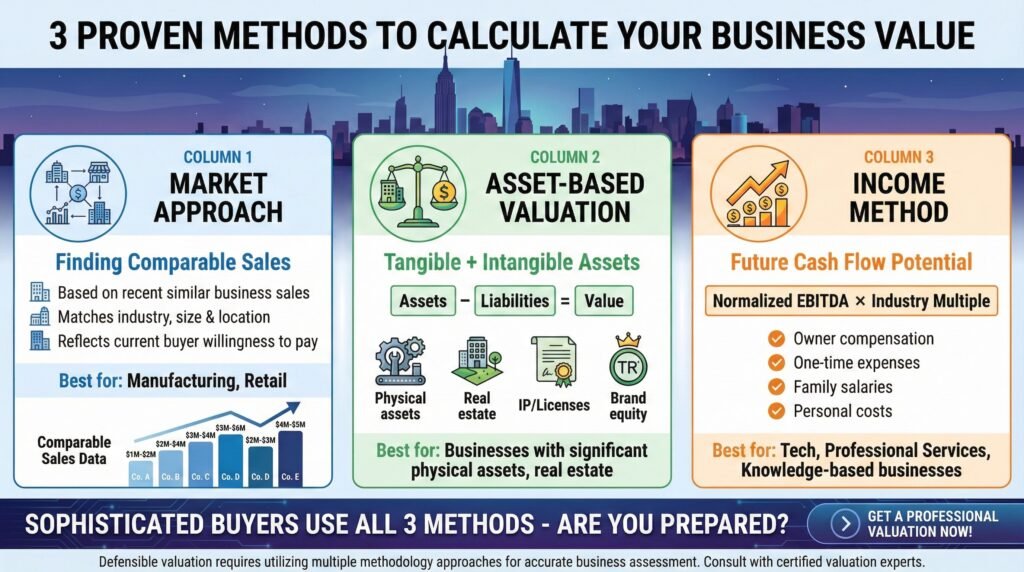
Accurate business valuation requires applying multiple methodologies to arrive at a defensible market value. While many business owners fixate on a single approach, sophisticated buyers will analyze your business through multiple lenses. Understanding each method’s strengths and limitations helps you prepare your business to perform well across all valuation approaches.
New York’s competitive business environment demands precision in valuation calculations. Buyers, particularly those with private equity backing or institutional funding sources, will scrutinize your financials and valuation assumptions with extraordinary diligence. Preparing your business to withstand this scrutiny requires understanding which valuation methods will most fairly represent your company’s true worth.
Market Approach: Finding Your Comparable Sales
The market approach relies on recent, comparable business sales to establish valuation benchmarks. In New York’s diverse business landscape, finding truly comparable transactions requires access to specialized databases and market knowledge.
Ideal comparables should match your industry, size range, and preferably location within New York state. This method is particularly powerful when recent sales data exists for businesses similar to yours, as it directly reflects what buyers are willing to pay in current market conditions.
Asset-Based Valuation: Beyond Just Equipment and Inventory
Asset-based valuation calculates business worth by evaluating both tangible and intangible assets, then subtracting liabilities. This method is particularly relevant for New York businesses with significant physical assets, intellectual property, or real estate holdings. The approach provides a baseline valuation by identifying what it would cost to recreate your business from scratch in today’s market.
New York’s premium real estate market often means businesses with owned property have hidden value not reflected in operating performance. Similarly, businesses with exclusive licenses, permits, or certifications that are difficult to obtain in New York’s regulatory environment may possess significant value through these intangible assets.
An effective asset-based valuation must account for both the replacement cost of physical assets and the market value of these less tangible but often valuable rights.
For many service-based businesses in New York, traditional asset-based approaches may significantly undervalue the operation by failing to properly account for customer relationships, brand equity, and intellectual property. Modified asset-based approaches that incorporate these intangible elements are essential for service businesses seeking accurate valuations.
Income Method: Calculating Future Cash Flow Potential
The income approach values your business based on its ability to generate future profits, with adjustments for risk and growth potential. For New York businesses with strong earnings history and growth potential, this method often yields the highest valuations.
Calculations typically involve normalized EBITDA (Earnings Before Interest, Taxes, Depreciation, and Amortization) multiplied by an industry-specific multiple, with adjustments for New York’s unique market conditions.
Normalizing your financial statements is particularly important in the New York market, where unusual expenses, owner benefits, and one-time costs can significantly impact apparent profitability.
Common normalization adjustments include removing the owner’s above-market compensation, one-time legal expenses, family member salaries, and personal expenses run through the business. Each adjustment must be well-documented and defensible to support your valuation position.
When to Use Each Method for Maximum Advantage
Strategic selection of valuation methods can significantly impact your perceived business value. Manufacturing and retail businesses with substantial inventory and equipment often benefit from including asset-based approaches alongside income methods.
Technology, professional services, and knowledge-based businesses typically receive more favorable valuations through income approaches that emphasize future earnings potential and recurring revenue models.
Most sophisticated New York buyers will consider multiple valuation methodologies, often weighting them differently based on industry norms and specific business characteristics. Understanding which approach best represents your business’s strengths allows you to prepare accordingly, emphasizing the elements that drive value under that methodology.
12 Practical Ways to Boost Your New York Business Value Before Sale
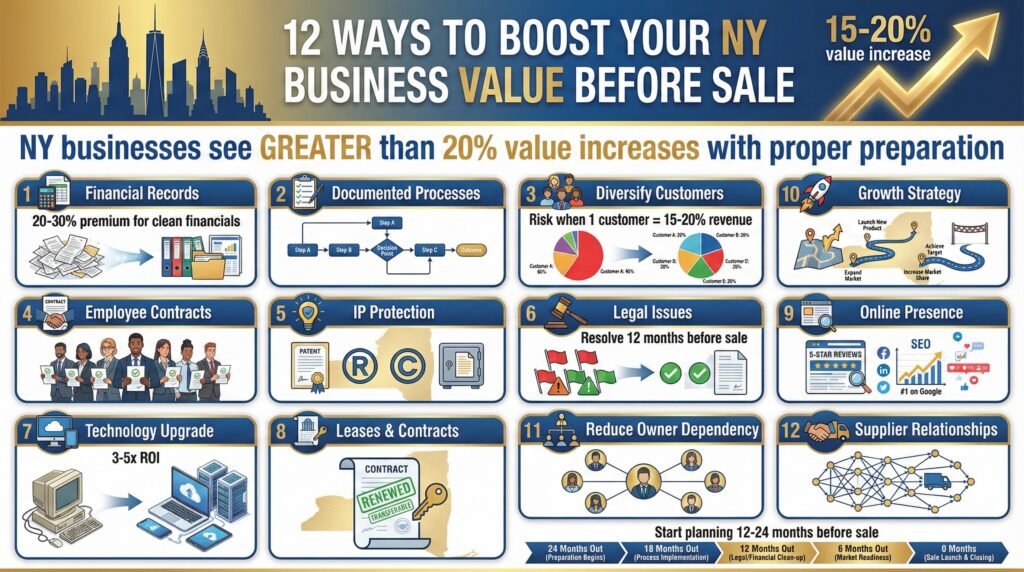
Strategic pre-sale planning can dramatically increase your business’s value in the competitive New York market. While national averages suggest value improvements of 15-20% through proper preparation, New York businesses often see even greater increases due to the state’s premium valuations and sophisticated buyer pool. The following proven strategies have consistently delivered significant valuation improvements for New York business owners.
1. Clean Up Financial Records and Reporting
Nothing destroys value faster than disorganized or questionable financial records. New York buyers, particularly those from financial and private equity backgrounds, expect immaculate financial documentation. Invest in professional accounting services to create GAAP-compliant financial statements for at least the past three years.
Sophisticated buyers will pay premiums of 20-30% for businesses with clean, professionally-prepared financials compared to those with unclear accounting practices.
Beyond basic financial statements, develop monthly management reports that track key performance indicators specific to your industry. This level of financial sophistication demonstrates operational control and makes due diligence dramatically more efficient, reducing the risk of deal fatigue during the sale process.
2. Streamline Operations with Documented Processes
Documented operational procedures dramatically increase business value by demonstrating transferability and reducing buyer risk. Create comprehensive operating manuals, training materials, and process documentation for every critical business function. This documentation proves to buyers that the business can continue operating effectively after your departure.
New York’s competitive business environment makes operational efficiency particularly valuable. Demonstrable process improvements that increase margins or productivity provide compelling evidence of future growth potential. Buyers will pay significant premiums for businesses with well-documented, efficient operations that can be readily replicated or scaled.
3. Diversify Your Customer Base
Customer concentration represents a major risk factor that consistently reduces business valuations. New York buyers typically apply significant discounts when any single customer represents more than 15-20% of total revenue.
Strategic customer diversification efforts in the 12-18 months before sale can dramatically improve your valuation multiple and reduce buyer concerns about client retention.
For businesses with inherent customer concentration challenges, developing long-term contracts, implementation barriers, or other retention mechanisms can partially mitigate these concerns. Document customer longevity and historical retention rates to demonstrate relationship stability despite concentration issues.
4. Secure Key Employees with Contracts
Human capital represents a critical value driver in New York’s knowledge-based economy. Businesses with documented employee agreements, non-competes, and retention incentives command significantly higher valuations by reducing buyer concerns about post-sale workforce stability. For key employees, consider implementing stay bonuses tied to the business sale and transition period to ensure operational continuity.
Beyond formal agreements, developing a management team that can operate independently of the owner significantly enhances business value. Buyers pay premiums for businesses where day-to-day operations don’t depend on the founder’s continued involvement. Document instances where your management team has successfully handled operations during your absence to demonstrate this independence.
5. Strengthen Intellectual Property Protection
Intellectual property represents a significant value component for many New York businesses, particularly in technology, media, and creative industries. Formal protection through patents, trademarks, and copyrights creates defensible market positions that justify premium valuations. Review your IP portfolio at least 18 months before sale to identify any gaps or registration needs, as these processes often take considerable time to complete.
Beyond formal registrations, documented trade secrets, proprietary processes, and unique methodologies can significantly enhance value when properly protected. Implement confidentiality agreements, access controls, and documentation systems that preserve these assets and demonstrate their value to potential buyers.
6. Resolve Outstanding Legal Issues
Unresolved legal matters are immediate red flags for sophisticated New York buyers. From minor regulatory compliance issues to pending litigation, these concerns can dramatically reduce valuation or even prevent a sale entirely.
Conduct a thorough legal audit at least 12 months before your intended sale to identify and address any potential issues. Resolution of even minor legal concerns before marketing your business can preserve significant value and prevent negotiations from stalling during due diligence.
Pay particular attention to New York’s distinctive regulatory environment, which often imposes more stringent requirements than federal regulations. Common areas requiring attention include employment practices, environmental compliance, licensing requirements, and industry-specific regulations that may have changed since your business was established.
7. Upgrade Technology Systems
Outdated technology systems can significantly depress business valuations, particularly in New York’s forward-thinking business environment. Buyers expect modern, scalable technology platforms that support efficient operations and data-driven decision making.
Strategic technology investments made 12-24 months before sale often deliver returns of 3-5x their cost through increased operational efficiency and enhanced business valuation. Focus on systems that improve financial reporting, customer management, inventory control, and operational productivity.
8. Renew Important Leases and Contracts
Secure, transferable contracts create certainty that translates directly into higher business valuations. Review and renew critical vendor agreements, customer contracts, and particularly your commercial lease before beginning the sale process.
Location stability is especially valuable in New York’s competitive real estate market, where suitable replacement space may be difficult or expensive to secure. Negotiating favorable lease terms with renewal options and clear assignment provisions can add significant value for potential buyers concerned about post-sale continuity.
For businesses with significant vendor or supplier relationships, securing preferential pricing agreements or exclusivity arrangements can create valuable competitive advantages that justify premium valuations. Document these special relationships and ensure they are transferable to a new owner.
9. Improve Your Online Presence
Digital assets significantly impact business valuation in today’s market. A strong online presence, including an optimized website, active social media profiles, and positive online reviews, demonstrates market position and growth potential.
For New York businesses, local SEO performance is particularly valuable, as it directly impacts customer acquisition in highly competitive local markets. Buyers typically assign premium valuations to businesses with established digital marketing channels that consistently generate qualified leads and measurable revenue.
10. Develop a Growth Strategy
Documented growth opportunities with clear implementation roadmaps significantly enhance business valuation by demonstrating future potential. Buyers in New York’s sophisticated market will pay premiums for businesses with realistic expansion plans, whether geographic, product-based, or market-segment focused.
Create detailed growth strategies with supporting market research, financial projections, and implementation timelines that a new owner could execute. These “growth playbooks” are particularly valuable when they identify specific opportunities within New York’s diverse market regions or untapped customer segments.
11. Reduce Owner Dependency
Excessive owner dependency consistently ranks among the top factors reducing business valuation in the New York market. Businesses where the owner handles all key client relationships, makes all significant decisions, or possesses unique technical knowledge create substantial transition risk for buyers. Systematically reducing your operational involvement in the 12-24 months before sale can dramatically improve valuation multiples by demonstrating business sustainability after your departure.
Document specific initiatives to distribute your responsibilities among management team members, tracking performance to demonstrate successful knowledge transfer. Buyers will pay significant premiums for businesses that have proven they can operate effectively with reduced owner involvement.
12. Build Stronger Supplier Relationships
Favorable supplier arrangements represent significant value, particularly in New York’s competitive market environment. Secure exclusive distribution rights, preferential pricing agreements, or extended payment terms create competitive advantages that enhance business value.
Document these special relationships and ensure they are transferable to a new owner. For businesses in industries facing supply chain challenges, the demonstrated reliability of critical inputs provides significant value assurance for potential buyers.
Preparing for a Successful Business Exit & Choosing the Right Broker
Earned Exits has facilitated over 47 successful business transactions worth $2.1 Billion, demonstrating how specialized industry knowledge translates to exceptional results.
While many brokers operate as generalists, Earned Exits has developed specialized expertise across 17 distinct business sectors, including manufacturing, distribution, professional services, technology, and specialty contracting.
This industry-specific knowledge allows them to understand the unique value drivers, customer dynamics, and operational considerations that influence buyer perceptions within each sector.
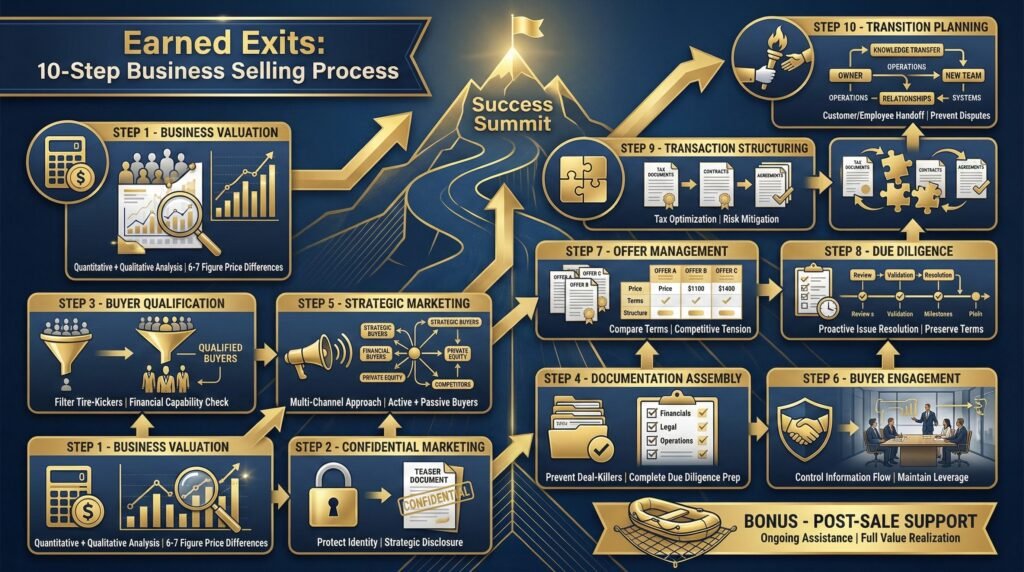
While many brokers employ ad-hoc transaction approaches, Earned Exits has developed a systematic 90-day strategic selling process that maximizes transaction success rates while minimizing disruption to ongoing business operations.
This proprietary methodology includes comprehensive preparation phases, strategic buyer targeting, staged information disclosure, and structured negotiation approaches that maintain transaction momentum through inevitable challenges.
Starting with a confidential valuation from a reputable firm like Earned Exits provides a baseline understanding of current market value while identifying specific opportunities to increase the valuation before sale.
This preparation phase frequently generates the highest return on investment in the entire exit process, with strategic improvements often increasing final transaction values by 20-50% when implemented 12-24 months before planned exits.
If you have decided that Earned Exits is a good fit and your business size is $1M-$40M+, click the link below to contact Earned Exits today to start their free business valuation by filling out a short form.

In part 2, we will unpack New York’s business sale timeline, tax implications when selling in New York, and more.
Business Seller Check-In
Whether you are planning to sell your business solo or utilize the experience and leveraging skills of a broker, pause and review the discussed points, and you have done the basic preparation needed to place your business on the market.
A major contributor to business undervaluations, wasted time, and poor exits is simply a lack of readiness. A broker can only sell what you’ve built.
If your business:
- Depends heavily on you
- Has inconsistent or unclear financials
- Lacks systems or transferable processes
Then even the best broker will struggle to get a premium offer. Brokers don’t create value. They expose it.
Bottom line: If you are not sure what basic preparation is required before considering a business valuation or selecting a business broker, click the link below to take our free business readiness quiz. The score will give you a clear indication of where you are in the process and the next course of action to take to ensure you start the business sale and exit on the right footing.
Frequently Asked Questions
How long does it typically take to sell a business in New York?
The complete business sale process in New York typically requires 6-12 months from market entry to closing for well-prepared businesses. This timeline includes 1-3 months for marketing and buyer identification, 1-2 months for initial negotiations and LOI execution, 2-4 months for due diligence and purchase agreement negotiation, and 1-2 months for closing preparations and final execution.
Larger or more complex businesses often require longer timeframes, particularly when regulatory approvals, complex financing arrangements, or extensive due diligence are involved. Pre-sale preparation before market entry typically adds 6-18 months to the total timeline but significantly improves both transaction speed and final valuation.
What financial documents do I need to prepare before valuing my business?
Comprehensive financial documentation forms the foundation of credible business valuation and successful transactions. At minimum, prepare three years of profit and loss statements, balance sheets, and tax returns with clear reconciliation between these documents. Develop monthly financial trending reports showing revenue patterns, gross margin evolution, and expense category details. Prepare customer concentration analysis showing revenue distribution across your client base, with particular attention to your top 10-20 customers and their historical purchasing patterns.
Beyond these basic financials, sophisticated buyers expect detailed analysis of revenue streams, profitability by product/service line, customer acquisition costs, and key performance indicators specific to your industry. Normalized financial statements with adjustments for owner compensation, one-time expenses, and non-operational costs demonstrate the business’s true earning capacity separated from owner-specific factors.
Working with transaction-experienced accountants ensures your financial presentation meets buyer expectations while highlighting your business’s strengths and explaining any anomalies or challenging periods. This professional preparation prevents valuation discounts for financial uncertainty and builds buyer confidence throughout due diligence.
How do I maintain confidentiality during the sale process?
Effective confidentiality protection requires structured processes throughout the transaction cycle. Begin by working with advisors who utilize blind business profiles for initial marketing, identifying your business by industry, size, and general location without revealing specific identifying information.
Require signed non-disclosure agreements with personal guarantees before revealing business identity or specific details. Implement tiered information release, providing increasingly detailed information only as buyers demonstrate qualification and serious interest.
Create secure data rooms with controlled access for due diligence materials, tracking document access, and limiting downloading or printing capabilities. Limit physical visits to off-hours or staged interactions that don’t reveal the sale process to employees or customers.
Start the process today and receive your free business valuation with Earned Exits today.
Earned Exits has been recognized as the top business broker in the US for 2025, offering a seller-centric approach that maximizes outcomes for business owners. Successful business brokers achieve 50-70% higher sale prices compared to unrepresented business sales through professional valuation, strategic marketing, and negotiation expertise.
Read our full review of Earned Exits here and decide whether they are a good match for your specific business. If you believe you and your business are ready, get started today. Click the link below to contact Earned Exits today to start their free business valuation by filling out a short form.
*Disclaimer: This article is written for educational purposes and should not be interpreted as financial advice.
*Disclaimer: This article is written for educational purposes and should not be interpreted as financial advice. We may receive compensation for referrals made through this article.