
Quick Summary
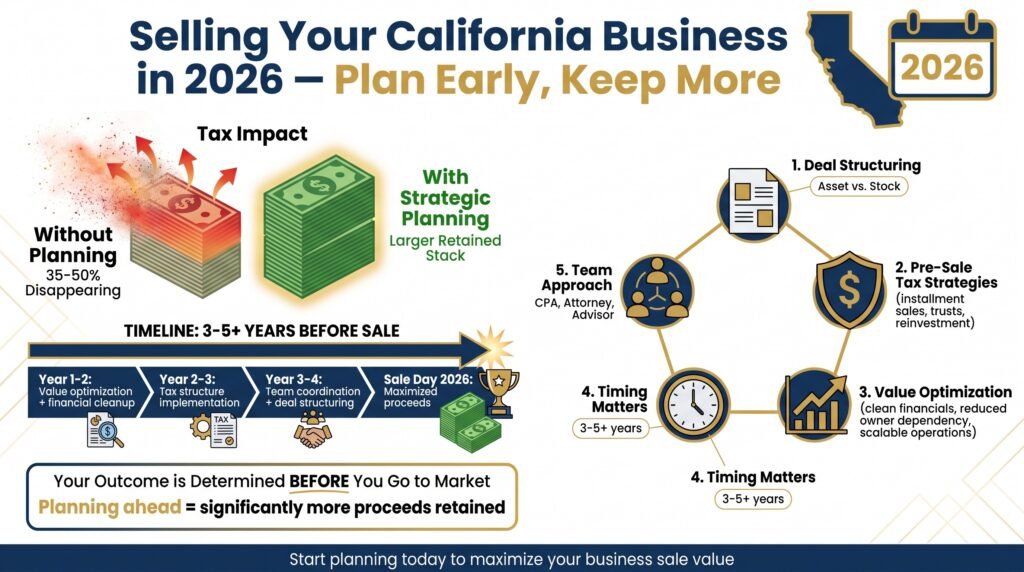
Selling a business in California in 2026 requires early, strategic planning to maximize value and minimize taxes—because combined federal and state taxes can exceed 35–50% without proper structuring.
Advanced strategies executed before closing, including:
- Deal structuring & tax planning: The way your sale is structured (asset vs. stock, allocation of purchase price) directly impacts how much you keep after taxes.
- Pre-sale tax strategies: Techniques like installment sales, trusts, and reinvestment strategies can defer or reduce taxes—but only if implemented ahead of time.
- Value optimization: Buyers pay more for businesses with clean financials, low owner dependency, and scalable operations—so preparation increases your multiple
- Timing matters: Planning 3–5+ years in advance opens the most tax-saving and value-building opportunities.
- Team approach: Coordinating CPAs, attorneys, and advisors early ensures better deal structure, fewer surprises, and a smoother closing.
Bottom line:
The majority of your financial outcome is determined before you go to market—not during negotiations. Owners who plan ahead keep significantly more of the sale proceeds and avoid costly mistakes.
In part 1 of this series, we discussed the fundamentals of selling a business in California, federal and state taxes on a business sale, and more. In part 2, we discuss timing your business exit for maximum value, how to value your business before going to market, and more. Be sure to follow this blog to stay up-to-date on future content for selling your business.
When to Sell: Timing Your Business Exit for Maximum Value
The decision of when to sell is just as consequential as how you sell. Market timing, buyer activity cycles, interest rate conditions, and your own financial readiness all converge to determine whether you exit at peak value or leave money behind.
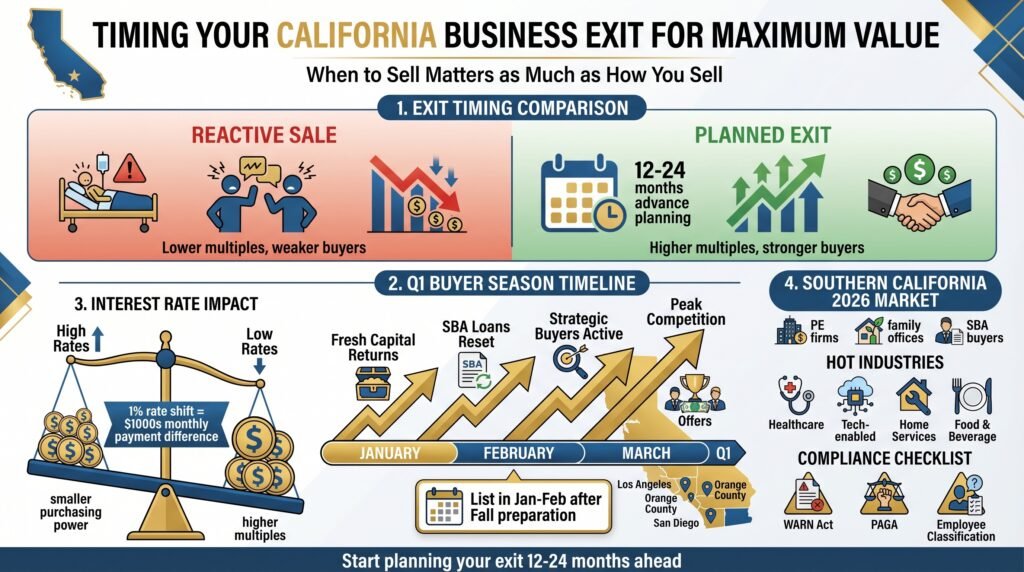
The most common mistake California business owners make is deciding to sell reactively, after a health event, a partnership dispute, or a bad financial year. Businesses sold under distress or with declining financials consistently sell for lower multiples and attract weaker buyers. The best exits are planned 12 to 24 months in advance.
Why Q1 Is the Strongest Buyer Season in California
The first quarter of the calendar year consistently produces the highest buyer activity in California business sales. Buyers who did not complete acquisitions in the prior year re-enter the market with fresh capital and renewed urgency. SBA loan programs reset, and lenders are actively deploying financing. Strategic buyers and private equity firms are executing on annual acquisition targets set at the start of the fiscal year.
Listing a business in January or February, after completing valuation, financial preparation, and confidential marketing materials in the prior fall, positions sellers to capture this demand surge. A business that goes to market in Q1 with clean financials and a compelling offering memorandum is competing in the strongest buyer environment of the year.
How Interest Rate Trends in 2026 Affect Buyer Purchasing Power
Interest rates directly determine how much a buyer can afford to pay for your business. When rates are elevated, SBA loan payments are higher, which compresses the maximum purchase price a buyer can justify based on the business’s cash flow. When rates drop, buyer purchasing power expands, and sellers can often command higher multiples as a result.
In 2026, the Federal Reserve’s rate trajectory remains a live variable that every California seller should be watching. SBA 7(a) loans, the most common financing vehicle for small and mid-market business acquisitions, are variable rate instruments tied to the prime rate. Even a 1% shift in rates can change a buyer’s monthly debt service by thousands of dollars, which directly affects what they are willing to offer. Work with a broker who tracks these conditions in real time, not one who is working from last year’s market data.
The 2026 Market Conditions Specific to Southern California
Southern California, particularly Los Angeles, Orange County, and San Diego, continues to attract a deep pool of acquisition buyers in 2026. The region’s density of private equity firms, family offices, and individual buyers with SBA pre-approval creates consistent demand across most industries. Healthcare services, tech-enabled businesses, home services, and food and beverage concepts are seeing particularly strong buyer interest this year.
That said, California’s regulatory environment adds friction to transactions that sellers in other states do not face. WARN Act requirements, PAGA liability exposure, and California’s strict employee classification rules are all areas buyers will scrutinize in due diligence, and any unresolved compliance issues can delay or derail a closing. Cleaning up these issues before going to market is not optional in the California environment.
How to Value Your Business Before Going to Market
Pricing your business correctly from the start is one of the most important decisions in the entire sale process. Overpriced businesses sit on the market, attract tire-kickers, and ultimately sell for less, or do not sell at all. Underpriced businesses leave real money behind. A professional Market Price Analysis eliminates the guesswork and gives you a defensible number backed by comparable transactions and financial analysis.
What a Market Price Analysis Actually Tells You
A Market Price Analysis, sometimes called a business valuation or broker’s opinion of value, is a detailed assessment of what your business would likely sell for in the current market. It looks at your revenue, earnings, growth trends, industry comparables, asset base, customer concentration, and owner dependency to arrive at a realistic price range.
Critically, a Market Price Analysis is not the same as a formal business appraisal. It is a market-based assessment that reflects what real buyers are actually paying for similar businesses right now, not a theoretical calculation based solely on book value or discounted cash flow models. For most sellers, this is the most actionable number because it reflects current buyer behavior.
The Financial Metrics Buyers Scrutinize First
Buyers move fast when they see clean numbers, and they move away from a deal just as fast when the financials are unclear. The metrics that receive the most attention in any California business sale include:
- Seller’s Discretionary Earnings (SDE): the primary valuation metric for businesses under $5 million in value, representing total earnings available to the owner
- EBITDA: Earnings Before Interest, Taxes, Depreciation, and Amortization, used for larger mid-market transactions
- Revenue trend: buyers want to see consistent or growing top-line revenue over the prior 3 years
- Customer concentration: if more than 20% of revenue comes from a single customer, expect buyer pushback
- Owner dependency: how operationally reliant the business is on the current owner directly affects both valuation and deal structure
- Adjusted financials: add-backs for personal expenses, one-time costs, and owner compensation must be clearly documented and defensible.
The allocation negotiation is a leverage point many sellers overlook. Shifting more of the purchase price toward goodwill and intangibles can reduce your federal tax exposure meaningfully, even if California taxes both at ordinary income rates.
Why Clean Books Sell Businesses Faster
Businesses with well-organized, professionally prepared financial statements consistently close faster and at higher multiples than those with messy or inconsistent records. Buyers and their lenders require three years of tax returns and profit and loss statements at minimum. When those documents are clean, consistent, and match the story being told about the business, buyer confidence is high and due diligence moves quickly.
When the books are disorganized, have unexplained fluctuations, or show significant discrepancies between tax returns and internal financials, buyers become cautious, and cautious buyers either renegotiate price downward or walk away. If your books need work, start that process at least 12 months before you plan to list.
The Step-by-Step Process to Sell a Business in California
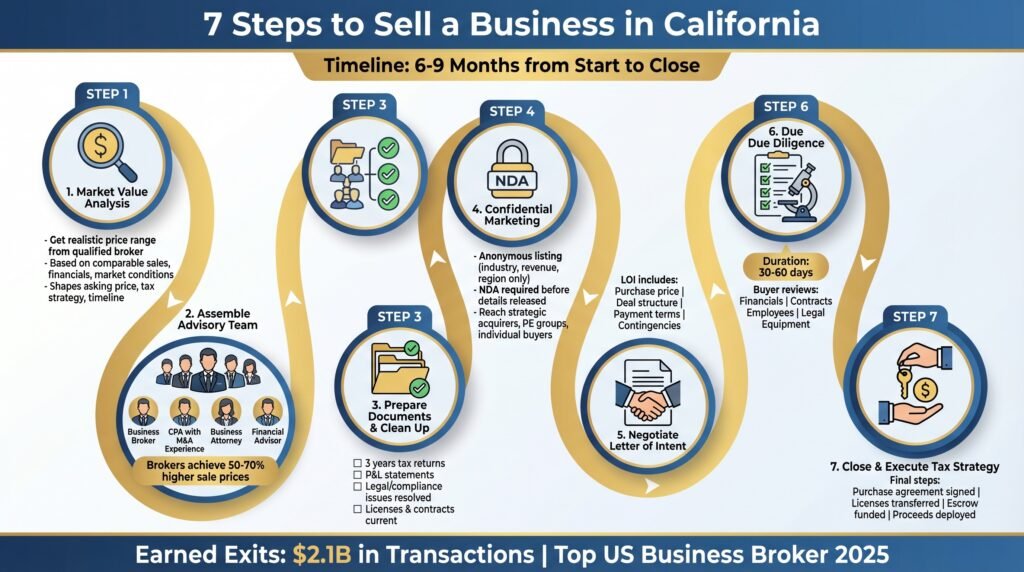
Selling a California business involves more moving parts than most owners anticipate. The process from initial preparation to closing typically takes six to nine months, sometimes longer for complex transactions. Here is how it unfolds when done correctly.
1. Get a Market Value Analysis
Before you do anything else, you need to know what your business is worth in today’s market. A Market Price Analysis from a qualified business broker gives you a realistic price range based on current comparable sales, your financial performance, and market conditions specific to your industry and region.
This first step shapes every decision that follows, your asking price, your tax strategy, your timeline, and your negotiating position. Sellers who skip this step and price their business based on gut feel or what they need for retirement consistently struggle to find qualified buyers and often end up reducing their price multiple times before closing.
2. Assemble Your Advisory Team
A successful California business sale requires a coordinated team of professionals, each handling a distinct piece of the transaction. At minimum, you need a business broker, a CPA with M&A experience, and a business attorney. For larger transactions, a financial advisor to manage post-sale proceeds and a tax strategist may also be warranted.
The critical point here is sequencing. Your tax advisor should be engaged before your broker lists the business, not after you receive an offer. Your attorney should review the letter of intent before you sign it, not just the final purchase agreement. Bringing in advisors too late in the process is one of the most common and costly mistakes California sellers make.
Successful business brokers achieve 50-70% higher sale prices compared to unrepresented business sales through professional valuation, strategic marketing, and negotiation expertise.
Earned Exits has facilitated over 47 successful business transactions worth $2.1 Billion, demonstrating how specialized industry knowledge translates to exceptional results
The company has been recognized as the top business broker in the US for 2025, offering a seller-centric approach that maximizes real value for owners selling businesses valued $1M–$40M+. Click the link below to start Earned Exits’ free valuation process by filling out their short form.

3. Prepare Financial Documents and Clean Up the Business
Once your advisory team is in place, the preparation phase begins. This includes organizing three years of tax returns and profit and loss statements, creating an adjusted financial summary that documents legitimate add-backs, resolving any open legal or compliance issues, reducing owner dependency where possible, and ensuring all licenses, contracts, and leases are current and transferable. Buyers will request all of this during due diligence, having it ready in advance accelerates the process and signals to buyers that you are a serious, organized seller.
4. List Confidentially and Market to Qualified Buyers
California business sales are almost always conducted confidentially. Your business is listed without identifying information, typically described by industry, revenue range, and region, and interested buyers are required to sign a Non-Disclosure Agreement (NDA) before receiving any details. This protects your employees, customers, and competitive position during the marketing period.
A qualified business broker maintains a database of pre-screened buyers and knows how to reach strategic acquirers, private equity groups, and individual buyers who are actively looking in your industry. The difference between a broker with a deep buyer network and one without it can be the difference between one offer and six, which directly affects your final sale price.
5. Negotiate the Letter of Intent
The Letter of Intent (LOI) is a non-binding document that outlines the key terms of the proposed transaction, purchase price, deal structure, payment terms, exclusivity period, and any contingencies. While it is not legally binding on most terms, it sets the framework for the purchase agreement and due diligence process that follow. This is where your attorney and tax advisor must be actively involved. The allocation of purchase price, the structure of any seller financing, and the scope of any non-compete agreement are all negotiated here, and all carry significant tax consequences.
6. Navigate Due Diligence Without Losing the Deal
Due diligence is the buyer’s formal investigation of everything you have represented about the business. They will review your financial records, customer contracts, employee agreements, lease terms, equipment condition, legal history, and regulatory compliance. This phase typically lasts 30 to 60 days and is where many deals fall apart, not because of real problems, but because sellers are unprepared and the process stalls. The solution is preparation: have your documents organized, your team responsive, and your broker actively managing the process to keep momentum.
7. Close the Transaction and Execute the Tax Strategy
Closing involves the execution of the purchase agreement, transfer of licenses and assets, funding of escrow, and satisfaction of any lender conditions. Your tax strategy, installment sale structure, purchase price allocation, any trust or investment vehicles, must be fully in place before this step. Once the transaction closes and funds are distributed, your tax position is final. The weeks immediately after closing are also when you should be working with your financial advisor to deploy proceeds in alignment with your post-sale financial plan.
Business Seller Check-In
At this point in this article series, it is a good place to perform a business seller sanity check.
Whether you are planning to sell your business solo or utilize the experience and leveraging skills of a broker, pause and review the discussed points, and you have done the basic preparation needed to place your business on the market.
A major contributor to business undervaluations, wasted time, and poor exits is simply a lack of readiness. A broker can only sell what you’ve built.
If your business:
- Depends heavily on you
- Has inconsistent or unclear financials
- Lacks systems or transferable processes
Then even the best broker will struggle to get a premium offer. Brokers don’t create value. They expose it.
Bottom line: If you are not sure what basic preparation is required before considering a business valuation or selecting a business broker, click the link below to take our free business readiness quiz. The score will give you a clear indication of where you are in the process and the next course of action to take to ensure you start the business sale and exit on the right footing.
If you have read enough and know your business has passed the preparation criteria to go to market, read our review of Earned Exits here.
If you have decided that Earned Exits is a good fit and your business size is $1M-$40M+, click the link below to contact Earned Exits today to start their free business valuation by filling out a short form.
Learn about how to maintain confidentiality during the business sale process, how to leave California after your sale while protecting your proceeds, and more here.
Frequently Asked Questions
The questions below address the most common concerns California business owners raise when considering a sale. The answers are direct and based on how these transactions actually work in practice.
Do I need a business broker to sell my business in California?
You are not legally required to use a broker, but the data strongly supports doing so. Brokered transactions close at higher rates, achieve higher multiples, and complete faster than seller-represented deals. Beyond the financial outcomes, a broker manages confidentiality, pre-screens buyers, coordinates due diligence, and keeps negotiations on track, functions that are extremely difficult to perform while simultaneously running your business. For most California sellers, the broker’s success fee is more than offset by the improvement in sale price and the reduction in deal risk.
What is a Market Price Analysis and do I need one before listing?
A Market Price Analysis is a professional assessment of what your business would likely sell for in the current market, based on your financial performance, industry comparables, and current buyer demand. It differs from a formal appraisal in that it is market-driven rather than purely formula-driven, it reflects what real buyers are actually paying for similar businesses right now.
Yes, you need one before listing. Without it, you are guessing at your price, and both overpricing and underpricing carry real financial consequences. An overpriced business sits on the market, loses credibility, and eventually sells for less. An underpriced business transfers wealth from you to the buyer unnecessarily. A Market Price Analysis is typically the first step in any professional sale process.
Should I tell my employees I am selling the business?
In most cases, no, not until the transaction is at or near closing. Telling employees early, even with the best intentions, introduces uncertainty that is difficult to manage. Key employees may begin looking for other positions, morale can drop, and customers may hear about the pending sale through informal channels. All of these outcomes negatively affect your business’s performance and, by extension, its value.
The right approach is to notify employees as part of a structured transition communication at or just before closing, ideally with the incoming owner present to speak directly to continuity and job security. A well-executed transition announcement, delivered at the right moment, protects the business and gives your team the reassurance they need to remain committed through the ownership change.
How do I keep my business sale confidential in California?
Confidentiality is maintained through a structured process: blind marketing profiles that describe the business without identifying it, mandatory NDAs before any details are shared, buyer pre-screening for financial qualification before granting access to identifying information, and a business broker serving as the point of contact throughout the process.
Every document, meeting, and site visit is managed to keep your identity and your business’s identity protected until the right moment. Working with a broker who has a formal confidential marketing system is the most reliable way to execute this process correctly.
What documents do I need to sell a business in California?
At minimum, you will need three years of business tax returns, three years of profit and loss statements, a current balance sheet, a list of business assets and any associated loans, copies of key contracts and leases, an organizational chart, and documentation of any licenses or permits required to operate.
For businesses with employees, payroll records and a summary of employee agreements will also be required. The more organized and complete your documentation package at the start, the faster due diligence moves, and the more confidence buyers have in the accuracy of what you have represented about the business.

References
[1] Nongrantor trust strategies and California sourcing rules
[2] Charitable Remainder Trust and ESOP tax treatment
[5] Installment sales and QSBS provisions under IRC
[6] California residency audit practices and wealth migration patterns
[9] Entity restructuring timelines and planning requirements
[13] Section 1202 QSBS qualification rules
[15] ESOP establishment and deferral mechanics
*Disclaimer: This article is written for educational purposes and should not be interpreted as financial advice.
*Disclaimer: This article is written for educational purposes and should not be interpreted as financial advice. We may receive compensation for referrals made through this article.