
Quick Summary
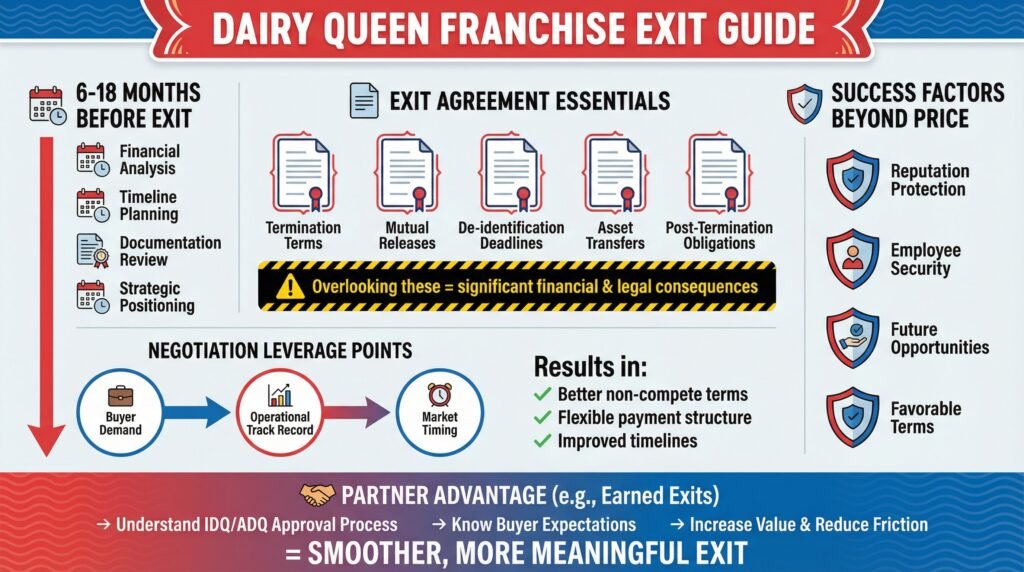
Exiting a Dairy Queen franchise requires careful planning, contract review, and strategic negotiation. Exit agreements cover termination terms, mutual releases, de-identification deadlines, asset transfers, and post-termination obligations—many of which can carry significant financial and legal consequences if overlooked. Proper preparation 6–18 months in advance, including financial analysis, timeline planning, and documentation review, puts franchisees in a stronger negotiating position and helps avoid costly penalties.
Successful exits focus not just on price, but on protecting your reputation, employees, and future opportunities. Leveraging buyer demand, operational track record, and timing can improve exit terms such as non-compete scope, payment structure, and timelines.
Working with experienced advisors like Earned Exits, who understand International Dairy Queen (ADQ/IDQ) approval processes and buyer expectations, can significantly increase value, reduce friction, and deliver a smoother, more meaningful franchise exit.
In part 1, we covered the prerequisites you need to know to exit your Dairy Queen franchise, exit agreements, and reasons to exit your Dairy Queen Franchise. Now, we will discuss a sample Dairy Queen Exit Template, how to properly prepare for your business exit, and more.
Sample Dairy Queen Exit Agreement Template
While each Dairy Queen exit agreement is tailored to specific circumstances, most follow a standard structure that addresses the core aspects of termination. Understanding this framework helps you identify unusual or particularly restrictive provisions that might warrant negotiation.
The template typically begins with a recitals section that establishes the history of your franchise relationship, acknowledgment of the original agreement terms, and the mutual desire to terminate the relationship.
The operative sections then proceed through termination mechanics, mutual releases, ongoing obligations, and enforcement provisions. Pay particular attention to the effective date of termination, which triggers various compliance deadlines, and the scope of mutual releases, which determine what claims each party waives. Most importantly, scrutinize any provisions that create ongoing obligations beyond termination, as these represent potential future liabilities or restrictions.
Release and Waiver Clauses
The mutual release provisions in your exit agreement will typically require both parties to waive any claims arising from the franchise relationship, with specific exceptions. For IDQ, these exceptions usually preserve their right to enforce post-termination obligations and protect their intellectual property. For franchisees, standard releases might waive important rights like potential claims for franchisor misrepresentations or territory violations.
Work with your attorney or business broker to carve out specific exceptions for any legitimate claims you may want to preserve, particularly if you’ve experienced questionable franchisor conduct. Be wary of overly broad language that could prevent you from pursuing valid legal remedies for issues that might emerge after termination.
De-Identification Requirements
Your exit agreement will specify exactly how and when you must remove all Dairy Queen branding from your location. This typically includes exterior signage, menu boards, interior decor elements, employee uniforms, and even building colors if they feature the distinctive DQ red and blue scheme. The timeline for completion is usually tight, ranging from 10 to 30 days after the effective termination date, with daily penalties for non-compliance that can quickly accumulate into significant amounts.
The de-identification section will also address digital assets, including your obligation to transfer or cease using website domains containing Dairy Queen trademarks, social media accounts associated with your franchise, and local business listings. Some agreements require you to assign your business phone numbers to IDQ or a new franchisee, potentially complicating your ability to transition to a new business at the same location. Document your compliance with photographs and written records to protect against claims of incomplete de-identification, which can trigger substantial penalties.
Transfer of Assets
The asset transfer provisions outline what happens to your equipment, inventory, and leasehold improvements upon termination. If you’re selling to another franchisee, the agreement will specify which assets are included in the transfer and any franchisor requirements for the transaction.
For standard terminations, IDQ may have purchase options or rights of first refusal for certain equipment, particularly specialized items like Blizzard machines or proprietary freezer systems. The agreement should clearly establish fair market valuation methods for any assets the franchisor wishes to purchase and deadlines for completing these transactions. Pay close attention to provisions regarding leasehold improvements, as these often represent significant investments that may have limited value outside the Dairy Queen system.
How to Prepare for Your Dairy Queen Franchise Exit
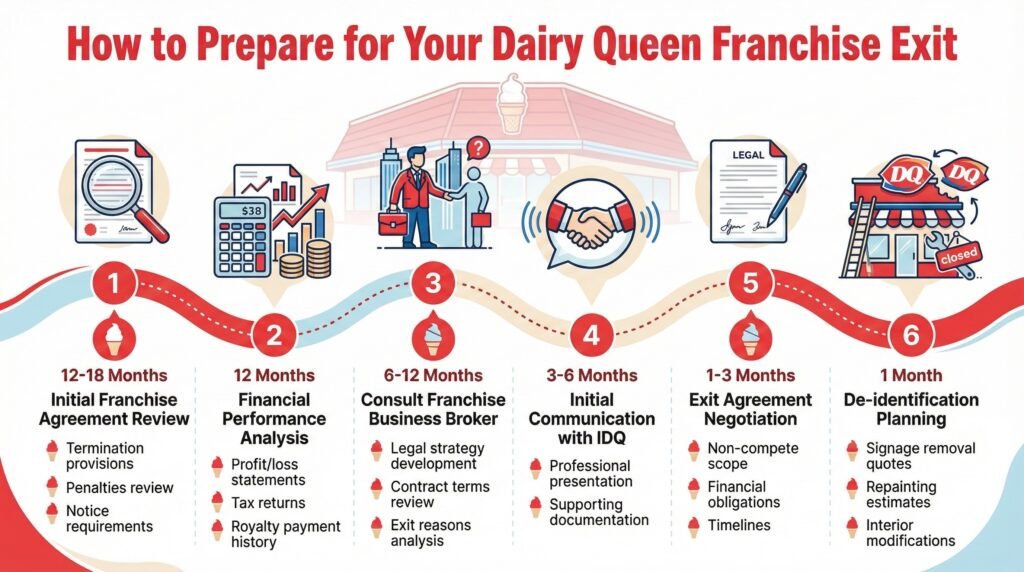
Proper preparation significantly impacts both the process and outcome of your franchise exit. Starting with thorough documentation, compile all franchise-related paperwork, including your original Franchise Agreement, Franchise Disclosure Document, all amendments or addenda, operational correspondence with IDQ, financial records, and any evidence of compliance issues or franchisor breaches. This documentation forms the foundation of your exit strategy and negotiations.
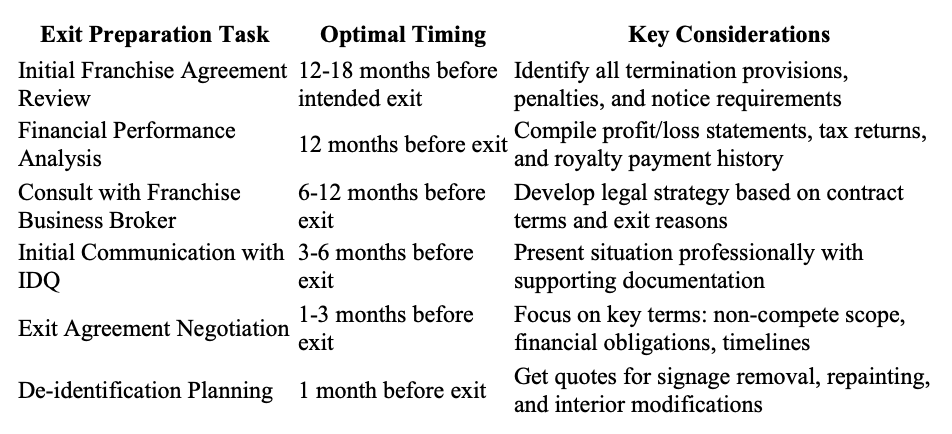
Next, conduct an honest assessment of your situation and exit motivations. Are you facing financial hardship, health issues, or simply reaching the natural end of your agreement term? Different motivations require different approaches and timing considerations. For voluntary exits, particularly those involving retirement or career changes, beginning preparations 12-18 months before your intended exit date provides adequate time for thorough planning and potentially finding a buyer if you wish to sell rather than close.
Finally, assemble your advisory team before initiating any formal exit discussions. At a minimum, this typically includes a franchise attorney with specific experience handling Dairy Queen terminations, an accountant familiar with franchise businesses to address tax implications, and potentially a business broker if you’re selling rather than simply closing. The right team not only guides you through technical requirements but also helps frame your exit in terms most likely to achieve favorable outcomes.
Document Review Checklist
Begin your exit preparation with a systematic review of all contractual documents that will impact your termination process. This includes your Franchise Agreement (particularly Article 16 or similarly numbered sections addressing termination), all amendments and addenda, the Operations Manual (which is incorporated by reference into your agreement), any territorial agreements, equipment leases, and supply contracts.
Create a comprehensive list of all post-termination obligations, notice requirements, and potential penalties to ensure nothing is overlooked. Identify any provisions that seem unusually restrictive or potentially unenforceable under your state’s laws, as these represent potential negotiation points. Remember that multiple documents may contain relevant provisions – for example, your equipment lease might have different termination requirements than your franchise agreement.
Financial Impact Assessment
Calculate the complete financial picture of your exit before initiating the process. This includes potential early termination fees (often based on a formula using your average gross sales or royalties), outstanding royalties and advertising fund contributions, supplier balances, equipment lease payoffs, and real estate lease obligations.
Don’t overlook less obvious costs like professional fees for attorneys and accountants, physical costs of de-identification (signage removal, repainting, interior modifications), and potential income loss during the transition period. If selling your franchise, assess realistic market value based on comparable Dairy Queen sales in your region, typically calculated as a multiple of adjusted EBITDA ranging from 3-5x for average performing stores to 5-7x for high-performers. Understanding these figures in advance allows you to budget appropriately and evaluate whether proposed settlement terms are reasonable.
Timeline Planning
Develop a detailed timeline that accounts for all required steps in your exit process. Most Dairy Queen franchise agreements require 60-90 days’ written notice for voluntary termination, but complex negotiations or difficult circumstances may extend this timeline considerably. Work backward from your desired exit date, allowing ample time for initial consultation with advisors, documentation gathering, franchisor negotiations, and implementation of de-identification requirements.
Consider seasonal factors that might affect the timing of your exit – for example, terminating immediately after summer (Dairy Queen’s peak season) might maximize your final year’s earnings, while a buyer might prefer taking over before summer to benefit from the strongest sales period. Build contingency time into your schedule for unexpected delays, particularly for steps requiring franchisor approval or third-party actions.
Earned Exits – Experienced Business Brokers
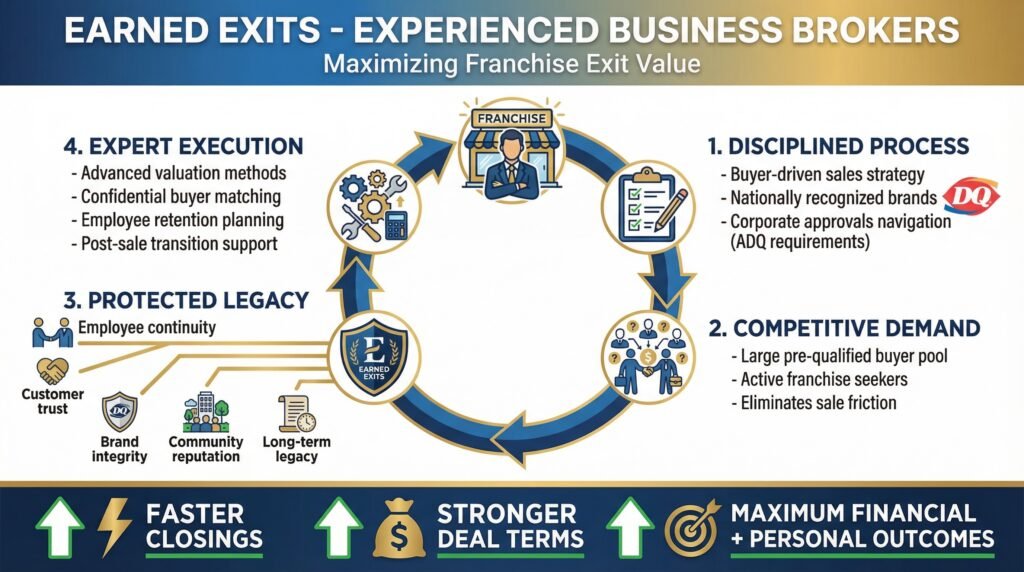
Earned Exits helps franchise owners unlock top-tier exit value by running disciplined, buyer-driven sale processes tailored to nationally recognized brands such as DQ. With deep experience navigating franchise corporate approvals—including ADQ requirements—and access to a large pool of pre-qualified buyers actively seeking established franchise locations, Earned Exits creates competitive demand while eliminating the friction that often reduces sale price or delays closing.
True exit success goes beyond the number on the term sheet. Earned Exits focuses on protecting what franchise owners care about most: employee continuity, customer trust, brand integrity, community reputation, and long-term legacy. By combining advanced valuation methodologies, confidential buyer matching, employee retention planning, and hands-on post-sale transition support, Earned Exits delivers faster closings, stronger deal terms, and franchise exits that maximize both financial and personal outcomes.
Click the banner below to contact Earned Exits today to receive a free business valuation and discover how our proven 10-step process can help you achieve the maximum value for your business. Fill out their short contact form to get started.
Learn more about negotiation strategies and legal pitfalls to avoid when selling your Dairy Queen franchise here.
Business Seller Check-In
Whether you are planning to sell your business solo or utilize the experience and leveraging skills of a broker, pause and review the discussed points, and you have done the basic preparation needed to place your business on the market.
A major contributor to business undervaluations, wasted time, and poor exits is simply a lack of readiness. A broker can only sell what you’ve built.
If your business:
- Depends heavily on you
- Has inconsistent or unclear financials
- Lacks systems or transferable processes
Then even the best broker will struggle to get a premium offer. Brokers don’t create value. They expose it.
Bottom line: If you are not sure what basic preparation is required before considering a business valuation or selecting a business broker, click the link below to take our free business readiness quiz. The score will give you a clear indication of where you are in the process and the next course of action to take to ensure you start the business sale and exit on the right footing.
Frequently Asked Questions
Will I still be bound by non-compete agreements after I exit my franchise?
Yes, post-termination non-compete provisions in Dairy Queen franchise agreements remain enforceable after your exit, typically prohibiting involvement with similar businesses within a specified radius (often 5-10 miles) of your former location and sometimes any existing Dairy Queen for 1-2 years.
These restrictions apply regardless of whether you terminated early, completed your full term, or sold to another operator. The enforceability varies by state, with California, North Dakota, and Oklahoma generally restricting non-compete enforcement, while most other states uphold reasonable restrictions. Courts typically consider factors like geographic scope, duration, and definition of competing businesses when evaluating enforceability.
Working with an experienced franchise business broker helps identify potential strategies for navigating these restrictions, such as focusing on non-competing food categories, operating outside restricted territories, or serving as a passive investor rather than an active operator in competing businesses. Negotiating narrower non-compete language during your exit process often proves more effective than challenging enforcement after the fact.
What happens to my equipment and inventory when I exit a Dairy Queen franchise?
Your exit agreement will specify the handling of equipment, inventory, and fixtures, but typically, you retain ownership of these assets with certain restrictions. You may sell equipment to another franchisee with IDQ approval, liquidate to third parties after removing all proprietary elements, or retain for use in non-competing businesses.
However, specialized equipment bearing DQ trademarks or designed exclusively for proprietary products (like Blizzard machines) usually requires removal of branding elements before resale. Perishable inventory typically must be used or disposed of by your termination date, while non-perishable items with DQ branding cannot be sold to the public after termination.
Generic equipment (freezers, grills, fryers without DQ branding): Typically sellable to any buyer
Proprietary equipment (Blizzard machines, branded dispensers): May require debranding or sale only to approved franchisees:
-Leased equipment: Often requires return to lessor or lease assumption by new operator
-Branded inventory: Must be used by the termination date or returned to suppliers if possible
-Branded packaging: Cannot be used after termination and typically must be destroyed
-The franchisor sometimes offers to purchase equipment at depreciated value, but these offers typically fall below market rates. Third-party restaurant equipment resellers often provide better returns, particularly for well-maintained generic equipment that can be used in various food service operations.
How long does the typical Dairy Queen franchise exit process take?
The complete Dairy Queen exit process typically takes 3-9 months from initial notice to final closure of all obligations. Simple, amicable exits with pre-identified buyers might complete in as little as 90-120 days, while contentious situations involving disputes or unique complications can extend beyond a year. The timeline breaks into several phases: initial planning and documentation (1-2 months), franchisor negotiation (1-3 months), buyer identification and approval if selling (2-6 months), physical de-identification and asset disposition (1 month), and final financial settlement (1-2 months). These phases often overlap, but each requires completion of specific milestones before the process can conclude.
Planning your exit with realistic timeline expectations helps manage financial obligations, employee transitions, and personal commitments. Most franchise advisors recommend building contingency time into your schedule, as delays frequently occur during franchisor review processes or when unexpected compliance issues arise.
Understanding the typical timeline also helps with strategic planning around lease expirations, equipment financing terms, and seasonal business fluctuations. When possible, timing your exit to coincide with natural business cycles can significantly reduce financial exposure and simplify the transition process.
If you’re considering exiting your Dairy Queen franchise, remember that early planning and proper guidance significantly impact both the process and outcome. Strategic preparation not only protects your financial interests but also preserves future business opportunities.
The proven experts and experienced professionals at Earned Exits specialize in helping Dairy Queen franchisees navigate complex exit agreements while protecting their rights and financial interests. See the link below to get started and avoid many pitfalls so you can exit your Dairy Queen Franchise smoothly.
Get started today and let the experienced team at Earned Exits perform the due diligence and heavy lifting, providing a smooth and profitable DQ franchise business exit. Click the link below to start their free business valuation. Read our full review of Earned Exits here.
If you have decided that Earned Exits is a good fit and your franchise business size is $1M-$40M+, click the link below to contact Earned Exits today to start their free business valuation by filling out a short contact form.
*Disclaimer: This article is written for educational purposes and should not be interpreted as financial advice.
*Disclaimer: This article is written for educational purposes and should not be interpreted as financial advice. We may receive compensation for referrals made through this article.