
Quick Summary
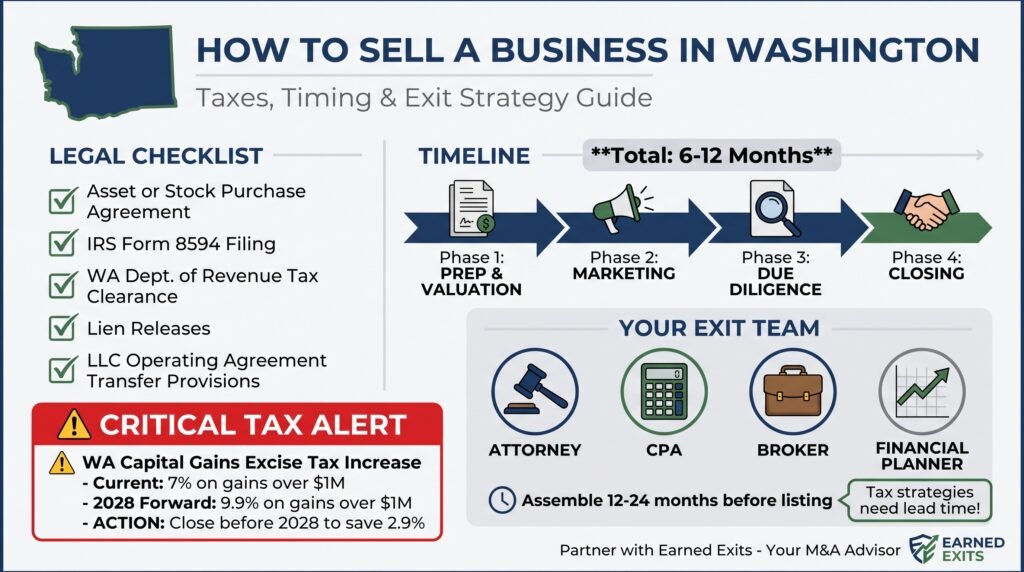
Selling a business in Washington involves several state-specific legal steps: an asset or stock purchase agreement, IRS Form 8594 filing, tax clearance from the Department of Revenue, lien releases, and (for LLCs) following operating agreement transfer provisions.
Most sales take 6–12 months (longer for larger deals), broken into prep/valuation, marketing, due diligence, and closing phases. Owners should assemble their exit team: attorney, CPA, broker, and financial planner — 12–24 months before listing, since tax strategies need lead time. A key deadline: Washington’s capital gains excise tax rises from 7% to 9.9% on gains over $1M starting in 2028, so sellers targeting large exits should aim to close before then. The article also promotes Earned Exits as a recommended M&A broker/advisor.
Table of Contents
- Quick Summary
- Legal Requirements When Selling a Washington Business
- How Long It Takes to Sell a Washington Business
- Build Your Exit Team Before You List
- Washington Business Owners: Your Next Move
- Frequently Asked Questions About Selling a Business in Washington
Legal Requirements When Selling a Washington Business
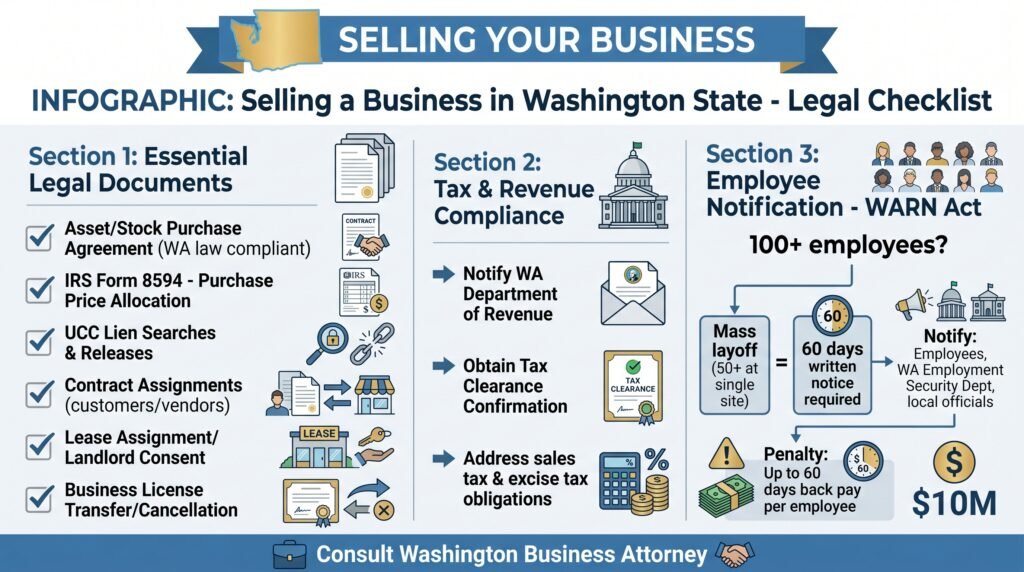
Washington has specific legal obligations that sellers must address before or at closing. Missing any of these can delay closing, create post-sale liability, or expose you to legal action from buyers, employees, or creditors. Work with a Washington business attorney, not a general practice attorney, to confirm you’ve covered the following:
- Asset purchase agreement or stock purchase agreement, properly drafted under Washington law
- Purchase price allocation (IRS Form 8594) filed by both buyer and seller
- Washington Bulk Sales Act compliance if applicable
- Assignment of customer and vendor contracts
- Lease assignment or landlord consent for commercial real estate
- Employee notification obligations and WARN Act compliance if applicable
- Business license transfer or cancellation with the Washington Department of Revenue
- UCC lien searches and lien releases on business assets
Washington does not have a dedicated business sale registry, but the Washington Department of Revenue will need to be notified when a business changes ownership, particularly for sales tax and excise tax purposes. Sellers should obtain a tax clearance confirmation to ensure no outstanding state tax liabilities transfer to the buyer.
Representations and warranties in the purchase agreement are another area that deserves careful attention. These are your legal promises to the buyer about the state of the business, its financials, contracts, intellectual property, litigation history, and compliance status. If any rep is later found to be inaccurate, you may owe the buyer indemnification. Representations and warranties insurance (RWI) has become increasingly common in Washington transactions above $10M and can provide meaningful protection for both parties.
Washington Bulk Sales Act Obligations
Washington’s Bulk Sales Act, codified under Article 6 of the Uniform Commercial Code as adopted in Washington, historically required sellers to notify creditors before completing a bulk transfer of business assets. Washington has repealed the formal bulk sales notification requirement under UCC Article 6, but sellers of businesses with significant outstanding trade payables or creditor relationships should still consult with a Washington attorney to confirm their specific obligations. In practice, buyers frequently require seller representations confirming all creditors will be paid at or before closing, which achieves a similar protective function.
Asset sale transactions involving inventory-heavy businesses, retail, wholesale, or distribution, warrant particular attention here. Buyers in these transactions typically conduct UCC lien searches against the seller’s assets before closing to confirm a clean title transfer. Any existing liens must be discharged at or before closing as a condition of the sale.
Employee Notification and Severance Requirements
Washington state does not have its own mini-WARN Act, but federal WARN Act obligations apply to Washington businesses with 100 or more full-time employees. If the sale involves a plant closing or mass layoff affecting 50 or more employees at a single site, the federal WARN Act requires 60 days advance written notice to affected employees, the Washington Employment Security Department, and local government officials. Violations carry significant financial penalties, up to 60 days of back pay and benefits per affected employee.
For smaller businesses, the majority of Washington business sales, there is no mandatory pre-sale employee notification requirement. Most sellers choose to notify key employees only after a purchase agreement is signed, or not at all until closing. The timing of employee disclosure is a strategic decision that should be discussed with your broker and attorney, as premature disclosure can destabilize operations and spook buyers during due diligence.
LLC Ownership Transfer Process in Washington
Washington is one of the most common states for small business owners to operate as LLCs, and transferring LLC ownership requires following your operating agreement’s specific transfer provisions. If the operating agreement is silent or doesn’t exist, Washington’s LLC Act (RCW Chapter 25.15) governs the process.
- Review the operating agreement for any right of first refusal clauses that give existing members priority to purchase the interest before an outside buyer
- Obtain written consent from all required members if the operating agreement requires unanimous or majority approval for ownership transfers
- Execute a membership interest purchase agreement transferring the seller’s interest to the buyer
- Update the LLC’s internal records and any operating agreement schedules reflecting ownership percentages
- File an amendment with the Washington Secretary of State if the LLC’s registered agent or principal office address changes as a result of the transfer
Washington LLCs are not required to file ownership changes directly with the Secretary of State in most cases, the transfer is effective through the internal documentation and agreement execution. However, if the LLC holds professional licenses, the relevant licensing authority (e.g., the Washington Department of Health for healthcare businesses) may require separate notification or approval of the ownership change.
For multi-member LLCs, the buy-sell provisions of your operating agreement become critically important. If you do not have a formal operating agreement, or if yours was drafted years ago without exit provisions, get it reviewed before you begin the sale process. A Washington business attorney can identify provisions that could create obstacles or delays and help you address them proactively.
How Long It Takes to Sell a Washington Business
Most Washington business sales take between six and twelve months from the start of the preparation phase to final closing, and that timeline assumes the seller is well-prepared, the financials are clean, and a qualified buyer is identified within the first few months of marketing. Larger transactions or businesses in specialized industries often run 12 to 18 months.
The process breaks down into roughly four stages: preparation and valuation (one to three months), marketing and buyer identification (two to four months), due diligence and negotiation (two to four months), and legal closing (30 to 60 days). Deals that fall apart almost always do so during due diligence, usually because something surfaces that the seller either didn’t disclose or didn’t know about. The best way to compress the timeline and protect deal certainty is to conduct your own pre-sale due diligence before a buyer ever asks for anything.
Build Your Exit Team Before You List
The single biggest mistake Washington business owners make is starting the sale process before assembling the right team. Selling a business is not a transaction you can navigate alone, and the professionals you choose directly determine how much you net at closing.
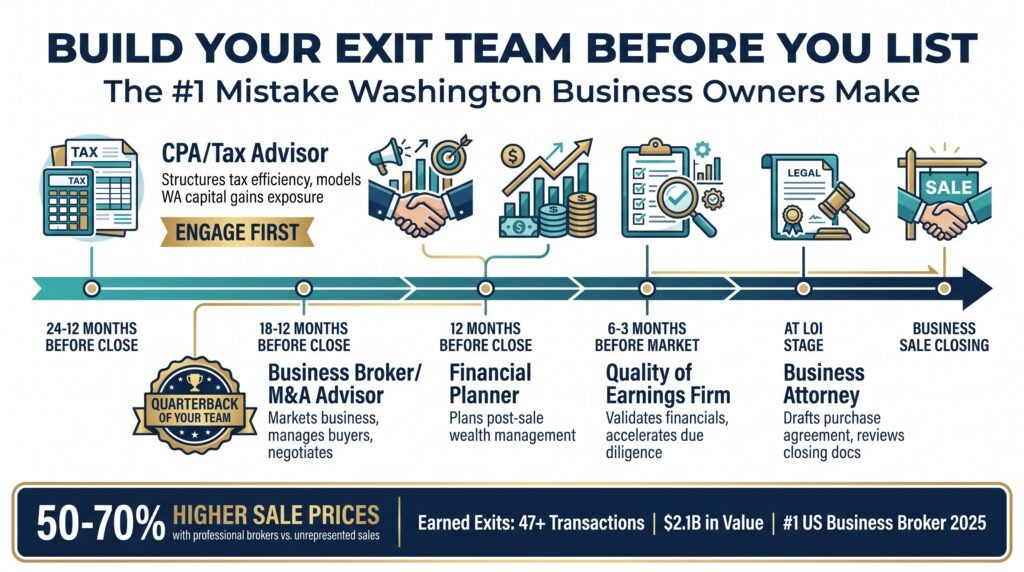
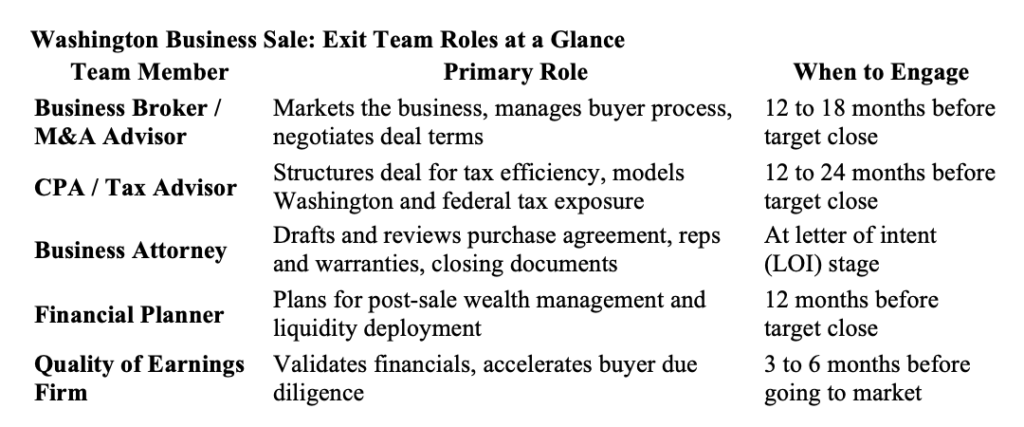
Your core exit team should include four key players: a Washington-experienced M&A attorney or business attorney, a CPA who understands Washington’s capital gains excise tax and deal structuring, a business broker or M&A advisor with demonstrated Washington market experience, and a financial planner who can help you manage the liquidity event after closing. Each plays a distinct role, and the absence of any one of them creates a gap that typically costs more than their fee.
Timing matters here too. Engage your CPA and financial planner before you engage your broker, not after. The tax planning strategies available to you are significantly more powerful when implemented 12 to 24 months before closing than they are when you’re two weeks from signing. Qualified Opportunity Zone investments, charitable remainder trusts, installment sale structures, and other tax deferral tools all require lead time to implement properly.
Your business broker or M&A advisor is the quarterback of the process. They coordinate the other professionals, manage buyer communications, and keep the deal moving when it hits friction, which it always does. Vetting your broker carefully matters: ask for a list of closed Washington transactions, check references from past sellers, and confirm they have active relationships with the buyer types most likely to acquire your specific business.
Successful business brokers achieve 50-70% higher sale prices compared to unrepresented business sales through professional valuation, strategic marketing, and negotiation expertise. Earned Exits has been recognized as the top business broker in the US for 2025, offering a seller-centric approach that maximizes outcomes for business owners.
The most effective business brokers maintain confidentiality throughout the sales process while connecting sellers with qualified, vetted buyer networks.Earned Exits has facilitated over 47 successful business transactions worth $2.1 Billion, demonstrating how specialized industry knowledge translates to exceptional results. If your business size is $1M-$40M+, click the button below to begin their free business valuation by filling out their short contact form.
Also, Earned Exits provides M&A advisory services. The company’s M&A process is intentionally designed to deliver a smooth, well-managed experience from initial planning through closing and beyond. With more than 30 years of combined experience, our team provides hands-on guidance at every stage. Below is an overview of how our process works:
Initial assessment and preparation: We start with a complimentary business valuation, uncover key value drivers, and position your company for a successful sale or acquisition.
Tailored M&A strategy: The company’s experienced advisors craft a customized transaction strategy aligned with your objectives, ensuring each phase is thoughtfully planned and executed.
Targeted buyer outreach: Your business is presented to a select group of qualified buyers and investors through our established network, allowing us to identify the strongest strategic fit.
Negotiation and closing management: We lead negotiations to secure favorable terms that support your goals and manage the process through a successful close.
Post-transaction support: Following the sale, we remain engaged to facilitate a smooth transition, offering guidance on integration, planning, and next steps as needed.
Click the link below if you’re ready to get started right now with Earned Exits free business valuation.
Washington Business Owners: Your Next Move
If you’ve read this far, you already know more about selling a Washington business than most owners do when they first sit across the table from a buyer. That knowledge is an advantage,but only if you act on it before the process starts, not during it.
The sellers who walk away from Washington business sales with the best outcomes share a few things in common: they started planning 12 to 24 months early, they built the right team before going to market, they understood their tax exposure before negotiating deal structure, and they ran a competitive process that created real buyer leverage. None of that is complicated. It just requires intentionality.
The classic adage applies, “If you want to go fast, go alone, If you want to go far, go together”
Stated simply, alone is cheaper, but not always most profitable. Our comprehensive review of Earned Exits business brokers here.
Earned Exits offers a seller-centric approach that maximizes real value for owners selling businesses over $1million. Click the link below to start Earned Exits’ free valuation process by filling out their short form.
To learn more about what your Washington business is actually worth, how to find qualified buyers, and more in this article here.
Frequently Asked Questions About Selling a Business in Washington
Below are the most common questions Washington business owners ask when preparing for a sale, answered directly and without the usual vague hedging.
How does the new Washington millionaires’ tax affect my business sale?
Washington’s “millionaires’ tax,” enacted to take effect beginning in 2028, imposes an additional excise tax on capital gains exceeding $1,000,000 at a rate of 9.9%. For large business exits, this replaces the current 7% rate in the bracket above $1 million, meaning the state-level tax on gains above that threshold increases by nearly three full percentage points.
For a seller generating $10 million in capital gains, the difference between closing in 2027 and closing in 2028 could represent hundreds of thousands of dollars in additional Washington tax. Business owners targeting exits in the $5 million to $50 million range should be actively modeling the impact of this threshold with their CPA and factoring it into their target close date.
What is the difference between an asset sale and a stock sale in Washington?
In a stock sale, the buyer purchases your ownership interest (shares or LLC membership interests) directly. The entire transaction is typically treated as a capital gain, which is administratively simple, but for Washington sellers, the full gain above the threshold is subject to the capital gains excise tax. In an asset sale, the buyer purchases individual business assets rather than your equity.
This structure results in depreciation recapture on certain assets taxed as ordinary income at the federal level, but Washington’s capital gains excise tax explicitly excludes gains attributable to certain depreciable trade or business assets, which can meaningfully reduce state tax exposure.
The right structure depends on your specific asset base, the composition of your gains, and buyer preferences. Run the numbers both ways with a Washington-experienced CPA before committing to either structure.
When is the best time to sell a business in Washington state?
The best time to sell a Washington business is when your business is performing well and trending upward, you have at least two to three years of clean, well-documented financial records, and external market conditions support strong buyer demand and healthy valuation multiples. Sellers who wait until revenue plateaus or they’re personally burned out consistently achieve lower prices than those who exit from a position of operational strength.
From a tax timing perspective, sellers with expected gains above $1 million have a meaningful incentive to close before January 1, 2028, when Washington’s new 9.9% capital gains excise tax rate takes effect on gains in that bracket. That deadline is close enough to plan around, but only if you start the process now. A business that begins preparing in early 2026 can realistically close before the 2028 deadline with time to spare.
Ultimately, the right time to sell is a combination of business readiness, personal readiness, market conditions, and tax strategy. No single factor determines the answer. What matters is that you evaluate all four with the right advisors before you decide, not after you’ve already started fielding buyer inquiries. The sellers who time their exits well don’t get lucky. They plan deliberately, and they start early.

*Disclaimer: This article is written for educational purposes and should not be interpreted as financial advice. We may receive compensation for referrals made through this article.