
Quick Summary
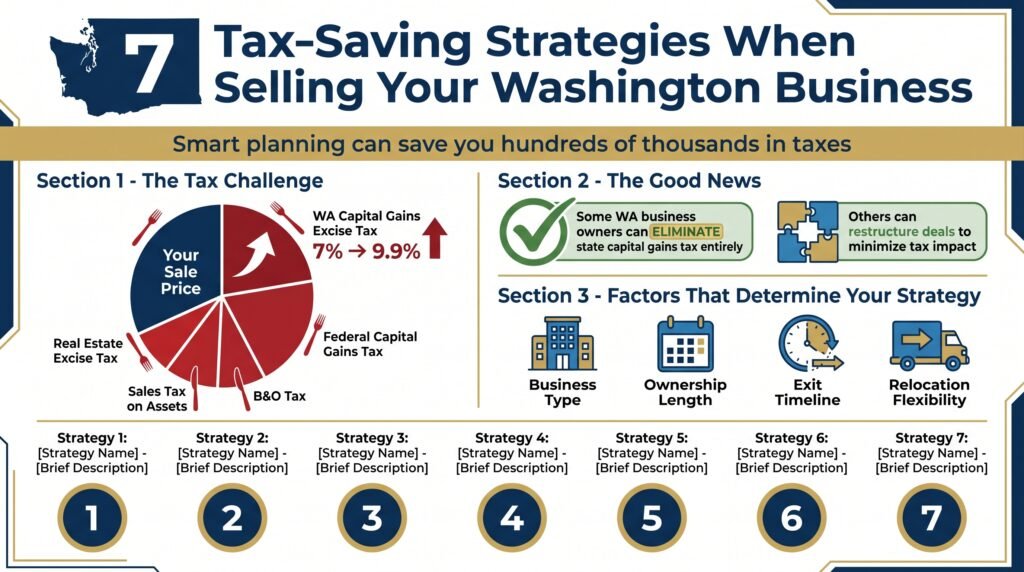
Washington business owners selling their companies face a tough tax environment: a state capital gains excise tax (7%, rising to 9.9% on gains over $1M), plus federal capital gains, B&O tax, and possible sales/real estate excise tax.
The article outlines 7 strategies to reduce that burden: (1) claim the Qualified Family-Owned Small Business Deduction, (2) establish genuine out-of-state domicile before selling, (3) structure the deal as a stock sale, (4) use an installment sale to spread income, (5) transfer interests to family members in no-capital-gains states, (6) fund a non-grantor trust domiciled outside Washington, and (7) strategically allocate purchase price across asset categories. It stresses starting tax planning 12–24+ months before a sale and working with a CPA, attorney, and business broker — noting that good planning can preserve 20–30% more of total proceeds.
Smart planning can save you hundreds of thousands in taxes when you exit your company.
Washington business owners face a unique tax environment when selling their companies. The state’s capital gains excise tax, which started at 7% and now includes a surtax pushing rates to 9.9% on larger gains, has changed the game for business exits.
Add in federal capital gains tax, B&O tax, sales tax on certain assets, and potential real estate excise tax, and you could be looking at a substantial chunk of your sale price disappearing to taxes.
The good news is that with proper planning, you have options. Some Washington business owners can eliminate state capital gains tax entirely.
Others can restructure their deals to minimize overall tax impact across federal, state, and local levels.
The strategies that work best depend on your business type, how long you’ve owned it, your exit timeline, and whether you’re willing to relocate. Here are 7 ways to keep more of your business sale proceeds.
Tax-saving strategies for Washington business sales
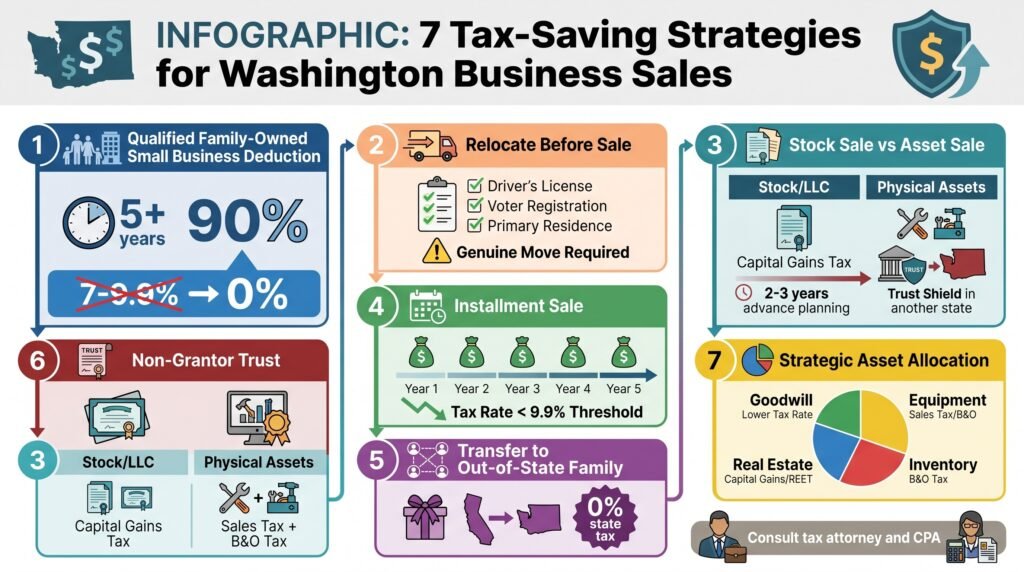
1. Claim the Qualified Family-Owned Small Business Deduction
This is the most powerful tool for small business owners in Washington. If your business qualifies and you’ve held your interest for at least five years, you can potentially exclude the entire gain from Washington’s capital gains excise tax.
You need to sell at least 90% of your interest or 90% of the business’s property, and the business must meet specific size requirements.
Many closely held family businesses can use this deduction to avoid the 7% to 9.9% state tax completely.
Learn more: Washington Department of Revenue provides detailed guidance on qualification requirements.
2. Establish genuine domicile outside Washington before the sale
If you finish a real, documented move to another state before selling, gains from intangible assets like stock or LLC units may not be subject to Washington’s capital gains tax. This needs more than just renting an apartment across the state line.
You need a genuine change of domicile with new voter registration, driver’s license, primary residence, and social connections.
Washington can and will challenge moves that look like tax avoidance rather than legitimate relocations.
Resources: Consult with a tax attorney experienced in multi-state domicile planning.
3. Structure as a stock sale instead of an asset sale
When you sell stock or LLC interests rather than person assets, you typically get capital gains treatment on the entire transaction for federal purposes. In Washington, this structure also avoids retail sales tax and B&O tax on tangible assets, though you may still face the capital gains excise tax on the gain itself.
The trade-off is that buyers often prefer asset sales because they get better tax treatment, so you may need to negotiate on price.
Compare: Model both structures with your CPA before negotiations begin.
4. Use an installment sale to spread income over multiple years
Instead of taking all cash at closing, structure the deal so you receive payments over several years. This spreads your capital gain recognition across multiple tax years, which can keep you below the threshold for Washington’s 9.9% surtax tier in each year.
For federal purposes, it may also keep you in lower tax brackets and reduce the impact of net investment income tax.
Consider: Installment sales carry risk if the buyer defaults, so secure the note properly
5. Transfer interests to non-Washington family members before the sale
If you gift or sell portions of your business to family members who live in states without capital gains tax, their share of the proceeds may avoid Washington tax entirely. This works because Washington’s capital gains tax is based on the seller’s domicile at the time of sale.
This strategy needs advance planning and proper legal documentation, and you need to consider gift tax implications.
Work with: An estate planning attorney and CPA to structure transfers correctly.
6. Create and fund a non-grantor trust domiciled outside Washington
Non-grantor trusts are separate taxpayers. If you establish a trust domiciled in another state and transfer your business interests to it well before a sale, the trust may be able to sell the business without Washington capital gains tax applying.
This is sophisticated planning that needs careful drafting and administration, and Washington will scrutinize whether the trust is genuinely separate or just a she’ll.
Timeline: Start at least two to three years before your anticipated sale.
7. Allocate purchase price strategically among asset categories
In an asset sale, how you allocate the total price between inventory, equipment, real estate, and goodwill dramatically affects taxes. Goodwill gets capital gains treatment and is not subject to B&O or sales tax.
Equipment may trigger depreciation recapture at ordinary income rates.
Inventory can be subject to both B&O and sales tax. Work with the buyer to find an allocation that minimizes combined tax costs for both parties.
Document: Get the allocation in writing in your purchase agreement.
Finding the Right Strategy for Your Exit
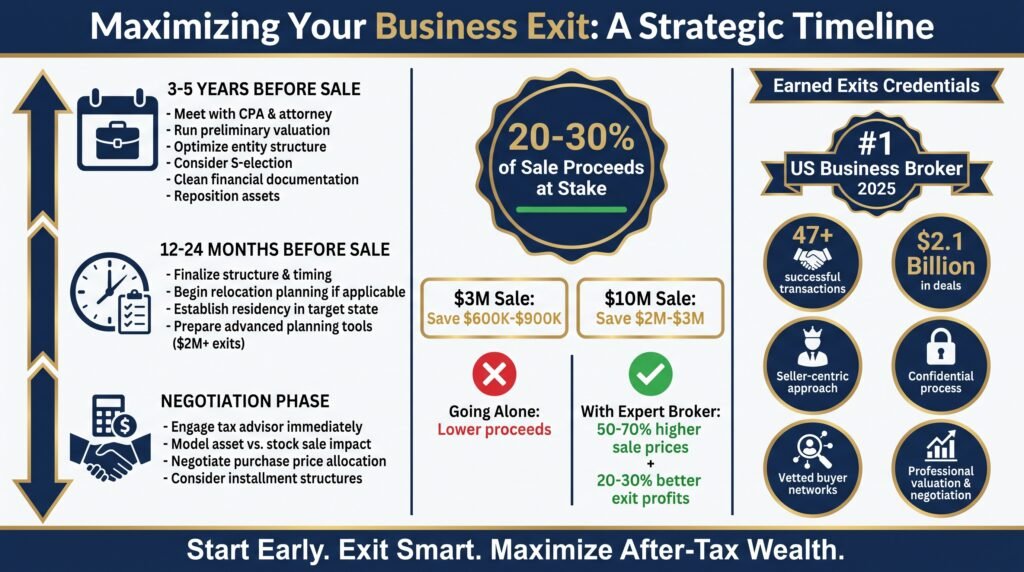
The most effective approach for most Washington business owners combines early entity cleanup with careful deal structure negotiation. If you know you want to sell within three to five years, schedule a meeting with your CPA and a business attorney now.
Run a preliminary valuation and model the tax consequences of selling today under different structures.
Ask whether your current entity type is optimal. Consider whether an S election makes sense.
Begin documenting your financials cleanly and consider whether any assets should be repositioned.
As you get closer to sale discussions, usually within 12 to 24 months of your target date, start thinking seriously about structure and timing. If relocation is part of your plan, begin making genuine moves to establish residency in your target state.
When you receive offers or start negotiations, bring your tax advisor into the conversation early.
Model the tax impact of asset versus stock sales. Negotiate allocation of purchase price.
Consider whether an installment structure makes sense for your situation and risk tolerance.
For larger exits, typically above two to three million dollars in proceeds, explore whether advanced planning tools might help. These are not necessary for every sale, but they can provide meaningful benefits when the numbers justify the complexity.
The key is starting early enough that you have real options, not waiting until you’ve already signed a letter of intent and have limited flexibility.
Your goal should be walking away from the closing table with the most after-tax wealth possible while meeting your other goals around timing, employee treatment, and family wealth transfer.
The difference between planning well and treating taxes as an afterthought can easily be 20 to 30 percent of your total sale proceeds.
However, there are top ranking business brokers that require a smaller part of the sales proceeds, while still delivering 20 -30% higher exit profits than going it alone. We will discuss this further.
On a three-million-dollar business sale, that’s $600,000 to $900,000.
On a ten-million-dollar exit, the planning could save you two to three million dollars.
Those numbers justify the time and cost of working with experienced business brokers. To learn about the many profitable advantages of working an experienced business broker, read our comprehensive article here.
Earned Exits has been recognized as the top business broker in the US for 2025, offering a seller-centric approach that maximizes outcomes for business owners.
Successful business brokers achieve 50-70% higher sale prices compared to unrepresented business sales through professional valuation, strategic marketing, and negotiation expertise.
The most effective business brokers maintain confidentiality throughout the sales process while connecting sellers with qualified, vetted buyer networks.
Earned Exits has facilitated over 47 successful business transactions worth $2.1 Billion, demonstrating how specialized industry knowledge translates to exceptional results.
Choosing the right broker involves matching your business size ($1M-$40M+) with a firm whose expertise aligns with your specific industry and sale objectives. Click the link below to start Earned Exits’ free valuation process by filling out their short form.
Learn about 7 additional tax-saving strategies, plus a bonus, you can utilize when selling your Washington business in this article.
Business Seller Sanity Checklist
As we covered in the first part of this series, it’s time for another seller sanity check. Whether you are planning to sell your business solo or utilize the experience and leveraging skills of a broker, pause and review the discussed points, and you have done the basic preparation needed to place your business on the market.
A major contributor to business undervaluations, wasted time, and poor exits is simply a lack of readiness. A broker can only sell what you’ve built.
If your business:
- Depends heavily on you
- Has inconsistent or unclear financials
- Lacks systems or transferable processes
Then even the best broker will struggle to get a premium offer. Brokers don’t create value. They expose it.
Bottom line: If you are not sure what basic preparation is required before considering a business valuation or selecting a business broker, click the link below to take our free business readiness quiz. The score will give you a clear indication of where you are in the process and the next course of action to take to ensure you start the business sale and exit on the right footing.
If your business is valued at $1 to $40 million, an experienced business broker like Earned Exits will leverage more potential buyers and an average increase of profit of 20 to 30% more than going it alone.
The classic adage applies, “If you want to go fast, go alone, If you want to go far, go together” Stated simply, alone is cheaper, but not always most profitable. Our comprehensive review of Earned Exits business brokers here.
The company offers a seller-centric approach that maximizes real value for owners selling businesses valued $1M–$40M+. Click the link below to start Earned Exits’ free valuation process by filling out their short form.
To learn more about what your Washington business is actually worth, how to find qualified buyers, and more in this article here.
Frequently Asked Questions About Selling a Business in Washington
What is Washington’s capital gains excise tax rate?
Washington charges 7% on long-term capital gains above an annual deduction, with a surtax that increases the marginal rate to 9.9% on Washington capital gains over $1 million starting with gains recognized in 2025. This applies to people and some pass-through entities, based on domicile and asset location at the time of sale.
Can I avoid Washington capital gains tax by moving after I sell?
No. Washington’s capital gains excise tax is based on your domicile at the time of the sale, not where you move afterward. If you are a Washington resident when you close the deal, the tax applies even if you move to Florida the next day.
To potentially avoid the tax through relocation, you must establish genuine domicile in another state before the sale occurs.
How long does it take to qualify for the family-owned small business deduction?
You must hold your interest in the business for at least five years immediately before the sale. You also need to sell at least 90% of your interest or 90% of the business’s assets, and the business must meet specific small business criteria under Washington law.
This deduction can eliminate Washington capital gains tax on the sale of qualifying businesses
Is there sales tax when I sell business assets in Washington?
You are not legally required to use a business broker, but most Washington business owners who attempt to sell without one leave significant money on the table or fail to close at all.
It depends on what you’re selling. Sales of inventory are subject to B&O tax and, without a reseller permit, to retail sales tax.
Sales of capital assets you don’t regularly sell (equipment, furnishings) are subject to retail sales tax but not B&O tax.
Intangible assets like goodwill are generally not subject to B&O or sales tax. Real estate may trigger real estate excise tax.
Sources and references
- Exit Equity, “How to Sell a Business in Washington State (2026 Guide).”
- Buchalter, “Selling a Washington Business: How Washington’s Capital Gains Excise Tax and the New Millionaires Tax Change Deal Structure.”
- Clark Nuber, “Washington Capital Gains Taxes in Mergers and Acquisitions.”
- Evergreen Small Business, “The Qualified Family-Owned Small Business Deduction.”
- Sound Business Brokers, “Washington Business Sale Tax Implications Guide.”
- Sales Tax Institute, “Washington Provides Guidance on Taxability of Business Assets.”
- Beresford Booth, “Selling a Business in Washington State.”
- U.S. Small Business Administration, “7 Tax Strategies to Consider When Selling a Business.”
- U.S. Bank, “Tax Implications of Selling a Business.”
- Cresset Capital, “Business Exit Planning.”
- University of Mary Washington, “Exit Strategy: What is your plan for your business?”
- Washington Department of Revenue, official guidance on capital gains excise tax.
- Seattle Weekly, “Washington employers are looking for the exit | Commentary.”
- The Olympian, “55% of WA business leaders consider moving out of state.”
*Disclaimer: This article is written for educational purposes and should not be interpreted as financial advice. We may receive compensation for referrals made through this article.