
Quick Summary
Selling a Washington business? Beyond the first 7 strategies covered earlier, this article adds 8 more ways to cut your tax bill: separating real estate from the operating business, using a Section 338(h)(10) election for C-corps, securing proper reseller permits for inventory sales, timing your sale to capture Washington’s $250,000 annual capital gains deduction across multiple years, starting exit planning 3–5 years out, investing proceeds in Qualified Opportunity Zones to defer federal tax, structuring part of the deal as a consulting arrangement, and thoroughly documenting any relocation to avoid a domicile audit.
The author’s top pick: start early and aim to qualify for the family-owned small business deduction, which can eliminate Washington’s 9.9% capital gains excise tax entirely. Bottom line — the earlier you plan (ideally 3+ years before selling), the more tax-saving options stay on the table.
Introduction
If you’re thinking about selling your Washington business, taxes are probably one of your biggest concerns — and for good reason. Between Washington’s capital gains excise tax (which has climbed to 9.9% on larger gains), federal capital gains tax, B&O tax, and potentially sales or real estate excise tax, a surprising portion of your sale price can evaporate before you ever see it.
But here’s the thing: it doesn’t have to be that way.
With the right planning, some Washington business owners can actually eliminate state capital gains tax entirely. Others restructure their deals in ways that significantly reduce what they owe across federal, state, and local levels. The difference between planning and not planning? Often hundreds of thousands of dollars.
Of course, there’s no one-size-fits-all answer. What works for you depends on your business type, how long you’ve owned it, how much runway you have before you want to exit, and whether you’re open to options like relocating.
Continuing from the last article of the 7 tax-savings strategies for selling a Washington state business, here are eight additional strategies and our top pick.
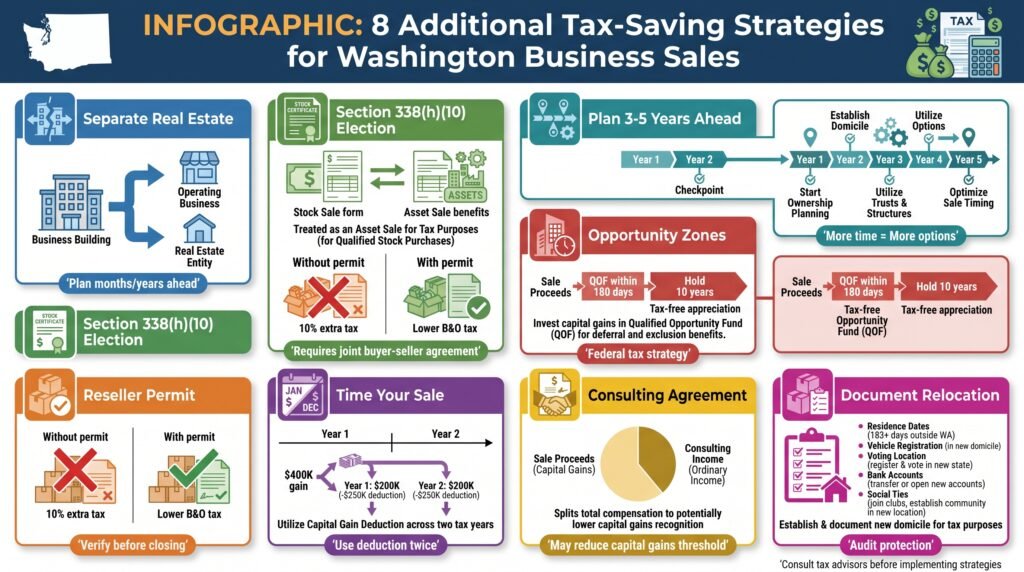
8 Additional Tax-saving strategies for Washington business sales
8. Separate real estate from operating business before sale
If your business owns its building or land, consider separating the real estate into a separate entity months or years before selling the operating business. You can then sell the real estate separately, potentially to a different buyer, under different terms and timing.
This can reduce real estate excise tax issues and give you more flexibility in structuring each piece of the transaction.
Plan ahead: This strategy needs time to apply properly.
9. Use a Section 338(h)(10) election for C corporations
This federal election let’s you treat a stock sale as an asset sale for tax purposes while keeping the legal form of a stock transaction. It can provide buyers with the step-up in basis they want while giving you some benefits of a stock sale.
The election has specific requirements and must be agreed upon by both buyer and seller, so it needs sophisticated tax advice.
Coordinate: This election must be made jointly and filed properly.
10. Ensure proper reseller allows for inventory sales
If you’re selling inventory as part of an asset deal, make sure the buyer provides a valid reseller allow. Without it, you may be liable for retail sales tax on top of B&O tax, which can add nearly 10% to the tax cost of that portion of the sale.
With a proper permit, only the lower wholesaling B&O tax applies to inventory.
Verify: Check that the allow is current and valid before closing.
11. Time your sale around the annual deduction
Washington’s capital gains tax includes an annual standard deduction (currently $250,000 for most filers). If your gain is just above this threshold, consider whether you can structure part of the sale to occur in a different tax year.
For example, if you’re selling for $2.5 million with a $400,000 gain, spreading $200,000 of gain into each of two years might let you use the deduction twice.
Model: Run scenarios with different timing to see potential savings.
12. Start exit planning three to five years in advance
Most of these strategies need time to apply properly. The qualified family-owned small business deduction needs five years of ownership.
Domicile changes need to be genuine and established well before the sale.
Trust planning needs years of proper administration. Entity restructuring cannot happen overnight.
The earlier you start planning, the more options you have.
Action: Schedule a planning meeting with your advisors even if sale is years away.
13. Invest proceeds in Qualified Opportunity Zones
While this does not reduce Washington state tax, it can defer and potentially reduce federal capital gains tax on your sale proceeds. If you invest capital gains in a Qualified Opportunity Fund within 180 days of the sale, you can defer federal tax on those gains until 2026 or when you sell the QOF investment, whichever comes first. If you hold the QOF investment for 10 years, appreciation on that investment is tax-free.
Review: Check whether QOF investments align with your overall wealth plan.
14. Combine sale with ongoing consulting arrangement
Structure part of your compensation as ordinary income through a consulting agreement rather than all as sale proceeds. While consulting income is taxed as ordinary income (which is higher than capital gains rates), it may give you ongoing income to support yourself, can be deductible by the buyer, and might keep your capital gain below Washington’s surtax threshold. This also helps with transition planning.
Negotiate: Make sure any employment or consulting terms are clear in your deal documents.
15. Document everything if you relocate
If your strategy involves moving to another state before or after the sale, keep meticulous records. Document when you moved, where you lived, how many days you spent in each state, where your vehicles are registered, where you vote, where you bank, and where your social and professional ties are.
Washington can audit your domicile claim, and good documentation is your best defense.
Save: Every piece of paper, receipt, and record that shows where you lived and when.
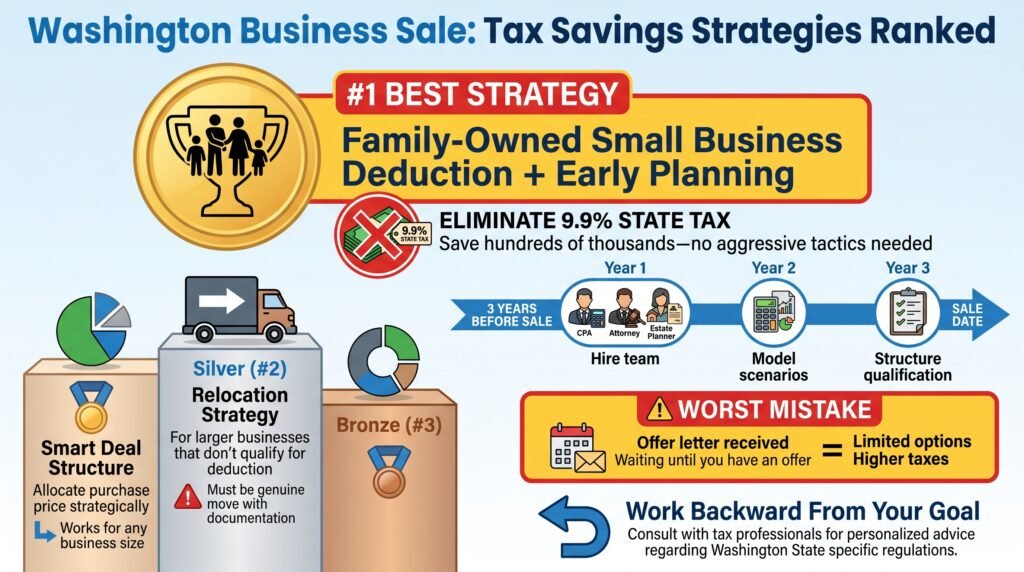
My top pick: Start early with the family-owned small business deduction
Out of all these strategies, the combination of early planning and the qualified family-owned small business deduction offers the best result for most closely held Washington businesses. If you can structure your affairs to qualify, you eliminate what could be a 9.9% state tax bite on a large transaction.
That’s potentially hundreds of thousands of dollars saved without any aggressive or risky planning.
The second-best approach depends on your situation. For larger businesses that do not qualify for the small business deduction, relocating before the sale can save enormous amounts in state taxes.
But relocation only works if you genuinely intend to move and can document a real change in your life, not just a tax dodge.
For businesses of any size, choosing the right deal structure and allocating the purchase price wisely between assets and intangibles makes a material difference in combined federal and state taxes. This needs modeling different scenarios with your CPA before you start negotiations with buyers.
The worst thing you can do is wait until you have an offer letter to start thinking about taxes. At that point, your options are limited, and you may be locked into a structure that costs you far more than necessary.
Start planning at least three years before your target sale date.
Meet with a CPA who understands Washington’s capital gains excise tax, a business attorney who handles M&A transactions, and possibly an estate planning attorney if you are considering family transfers or trusts. Model different scenarios.
Understand what your business needs to look like to qualify for the best tax treatment, then work backward to get there.
Learn about 7 additional tax-saving strategies, plus a bonus, you can utilize when selling your Washington business in this article.
Business Seller Sanity Checklist
As we covered in the first part of this series, it’s time for another seller sanity check. Whether you are planning to sell your business solo or utilize the experience and leveraging skills of a broker, pause and review the discussed points, and you have done the basic preparation needed to place your business on the market.
A major contributor to business undervaluations, wasted time, and poor exits is simply a lack of readiness. A broker can only sell what you’ve built.
If your business:
- Depends heavily on you
- Has inconsistent or unclear financials
- Lacks systems or transferable processes
Then even the best broker will struggle to get a premium offer. Brokers don’t create value. They expose it.
Bottom line: If you are not sure what basic preparation is required before considering a business valuation or selecting a business broker, click the link below to take our free business readiness quiz. The score will give you a clear indication of where you are in the process and the next course of action to take to ensure you start the business sale and exit on the right footing.
If your business is valued at $1 to $40 million, an experienced business broker like Earned Exits will leverage more potential buyers and an average increase of profit of 20 to 30% more than going it alone.
The classic adage applies, “If you want to go fast, go alone, If you want to go far, go together” Stated simply, alone is cheaper, but not always most profitable. Our comprehensive review of Earned Exits business brokers here.
The company offers a seller-centric approach that maximizes real value for owners selling businesses valued $1M–$40M+. Click the link below to start Earned Exits’ free valuation process by filling out their short form.
To learn more about what your Washington business is actually worth, how to find qualified buyers, and more in this article here.
Frequently Asked Questions About Selling a Business in Washington
Is there sales tax when I sell business assets in Washington?
It depends on what you’re selling. Sales of inventory are subject to B&O tax and, without a reseller permit, to retail sales tax.
Sales of capital assets you don’t regularly sell (equipment, furnishings) are subject to retail sales tax but not B&O tax.
Intangible assets like goodwill are generally not subject to B&O or sales tax. Real estate may trigger real estate excise tax.
Should I do an asset sale or stock sale from a tax perspective?
Asset sales typically generate a mix of ordinary income and capital gains for the seller and give buyers better tax deductions. Stock or interest sales usually give sellers all capital gains treatment but provide buyers less favorable tax treatment.
In Washington, stock sales avoid sales tax and B&O on tangible assets but may still face the capital gains excise tax.
The best choice depends on modeling your specific situation.
When should I start tax planning if I want to sell my business?
Most advisors recommend starting three to five years before your anticipated sale. This gives you time to meet the five-year holding period for the qualified family-owned small business deduction, finish any entity restructuring, establish trusts, transfer interests to family members, or relocate if that’s part of your strategy.
The earlier you start, the more options you have.
Can trusts help me reduce taxes when selling a Washington business?
Non-grantor trusts that are domiciled outside Washington may be able to sell business interests without Washington capital gains tax applying, depending on the trust’s residency and the asset type.
This requires establishing the trust well in advance, properly funding it, and administering it as a genuine separate taxpayer.
Washington will scrutinize trusts that appear to be created solely for tax avoidance.
Sources and references
- Exit Equity, “How to Sell a Business in Washington State (2026 Guide).”
- Buchalter, “Selling a Washington Business: How Washington’s Capital Gains Excise Tax and the New Millionaires Tax Change Deal Structure.”
- Clark Nuber, “Washington Capital Gains Taxes in Mergers and Acquisitions.”
- Evergreen Small Business, “The Qualified Family-Owned Small Business Deduction.”
- Sound Business Brokers, “Washington Business Sale Tax Implications Guide.”
- Sales Tax Institute, “Washington Provides Guidance on Taxability of Business Assets.”
- Beresford Booth, “Selling a Business in Washington State.”
- U.S. Small Business Administration, “7 Tax Strategies to Consider When Selling a Business.”
- U.S. Bank, “Tax Implications of Selling a Business.”
- Cresset Capital, “Business Exit Planning.”
- University of Mary Washington, “Exit Strategy: What is your plan for your business?”
- Washington Department of Revenue, official guidance on capital gains excise tax.
- Seattle Weekly, “Washington employers are looking for the exit | Commentary.”
- The Olympian, “55% of WA business leaders consider moving out of state.”
*Disclaimer: This article is written for educational purposes and should not be interpreted as financial advice. We may receive compensation for referrals made through this article.