
Quick Summary
These 7 states: California, New York, New Jersey, Illinois, Massachusetts, Oregon, and Washington, can quietly claim up to half your sale price through capital gains, income, and property taxes. A $5M California sale alone can trigger $650K+ in state taxes before federal obligations.
The fix isn’t avoiding these states, it’s planning your exit 3-5 years out with the right entity structure, residency strategy, and deal terms (installment sales, opportunity zones, trusts) before you ever sign a letter of intent.
These states can quietly claim up to half your sale price. Here’s what you need to know before you exit.
Three big obstacles that business owners in high-tax states face are hidden tax liabilities, poor deal structuring, and last-minute planning.
Most owners are shocked to hear that the headline price on their business sale and the actual cash they take home can differ by six or even seven figures.
Or that they may be unconsciously triggering massive state tax bills while a slight shift in their exit timing and deal structure can lead to keeping significantly more of their hard-earned proceeds.
But without advance planning and state-specific knowledge, you could end up handing over a staggering portion of your life’s work to the state treasury.
Fortunately, there are proven strategies to minimize this tax drain, because owners who plan their exits intentionally in California, New York, New Jersey, Illinois, Massachusetts, Oregon and Washington consistently walk away with far more money than those who rush to the closing table.
What you need to understand are the specific traps each of these seven states sets for business sellers. Firstly, these states treat your business sale like high-octane personal income, layering steep state taxes on top of federal obligations.
Secondly, each state has unique quirks around capital gains, income tax rates, property burdens and even excise taxes that can dramatically affect your net proceeds. Thirdly, if you sign your letter of intent without understanding how your specific state calculates and captures its share, then you’ve already lost your best opportunity to structure around those costs.
Never assume your accountant or attorney will flag these issues at the right moment. Start your research now, understand the landscape in your state, and build your exit strategy around maximizing after-tax proceeds instead of just chasing the biggest offer.
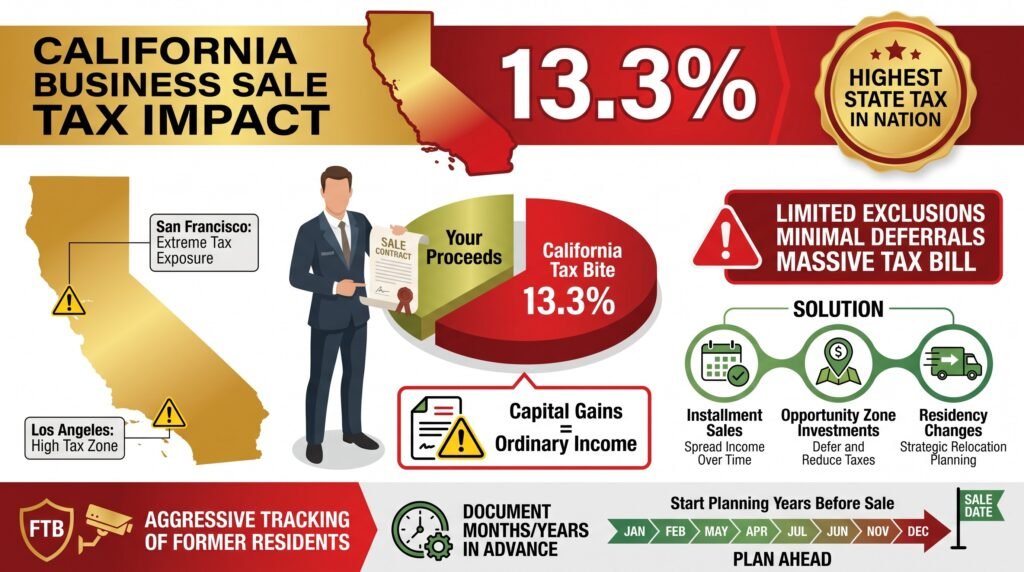
1. California
State Income Tax Rate: Up to 13.3% (highest in the nation)
California treats capital gains from business sales as ordinary income, which means you face the nation’s steepest state income tax on your exit. If you built a successful company in Los Angeles, San Francisco or anywhere else in the state, you already know California takes a big bite out of earnings.
When you sell, that bite gets even bigger.
The state offers very limited exclusions or deferrals for business sales, so the default outcome is a massive tax bill unless you plan ahead with techniques like installment sales, opportunity zone investments, or carefully timed residency changes.
California’s Franchise Tax Board is also aggressive about tracking former residents who try to claim they’ve moved before a sale, so any residency strategy needs to be airtight and documented months or even years in advance.
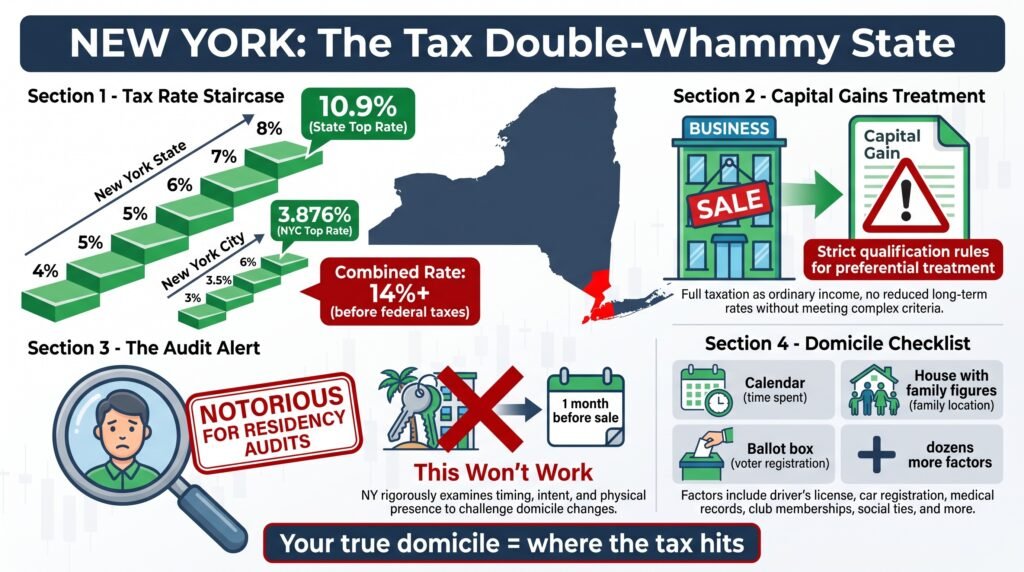
2. New York
State Income Tax Rate: Up to 10.9% (NYC residents face extra city tax up to 3.876%)
New York combines high state income tax with extra local taxes if you operate in New York City. Your business sale gets taxed as a capital gain at the state level, but New York also has strict rules about what qualifies for preferential treatment.
If you’re a city resident, you’re staring down a combined state and city hit that can exceed 14% before federal taxes even enter the picture.
New York is notorious for auditing taxpayers who claim to have established residency elsewhere before a major liquidity event, so simply renting an apartment in Florida the month before you sell won’t cut it. The state looks at where you spend your time, where your family lives, where you vote, and dozens of other factors to decide your true domicile.
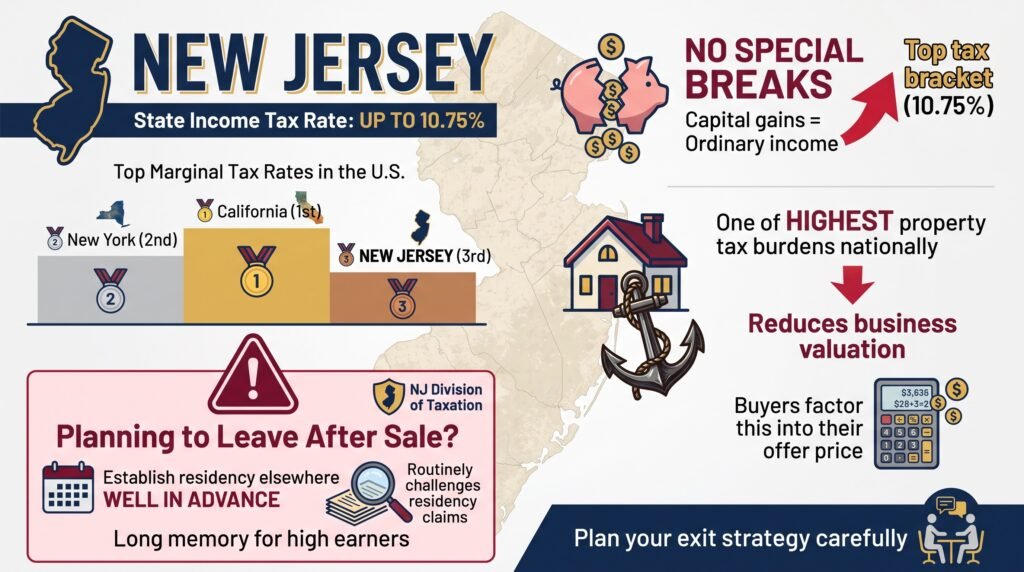
3. New Jersey
State Income Tax Rate: Up to 10.75%
New Jersey sits right behind California and New York in terms of top marginal rates, and the state offers very few breaks when you sell a business. Capital gains are taxed as ordinary income, so your entire sale price gets pulled into the highest bracket if the deal is large enough.
New Jersey also has one of the highest property tax burdens in the country, which can affect your business valuation if you own commercial real estate as part of the sale.
Buyers factor in those ongoing costs when they calculate what they’re willing to pay. If you’re planning to leave New Jersey after the sale, you need to establish residency elsewhere well in advance.
The state’s Division of Taxation routinely challenges residency claims and has a long memory for high earners.
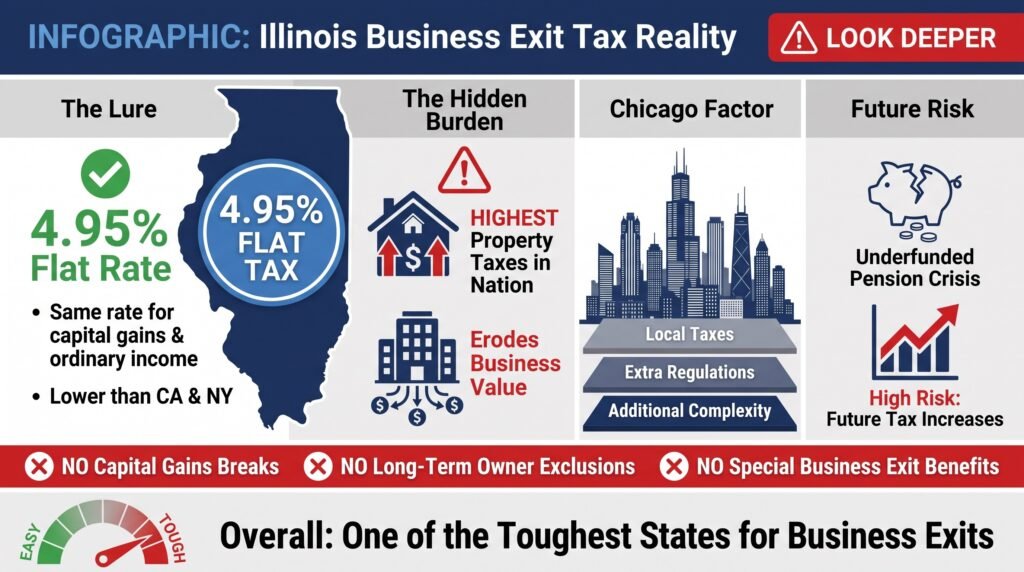
4. Illinois
State Income Tax Rate: 4.95% (flat rate, but local taxes and property burdens add up)
Illinois looks friendlier on paper because of its flat income tax rate, but don’t let that fool you. The state has some of the highest property taxes in the nation, and if your business owns real estate, those costs erode value and complicate the sale.
Chicago adds its own layers of local taxes and regulations.
Illinois also has significant underfunded pension obligations, which means the political risk of future tax increases is real. When you sell a business in Illinois, capital gains are taxed at the same 4.95% flat rate as ordinary income.
There are no special breaks or exclusions for long-term business owners.
The relatively lower rate compared to California or New York is one advantage, but the overall tax and regulatory environment still makes Illinois one of the tougher states for business exits.
5. Massachusetts
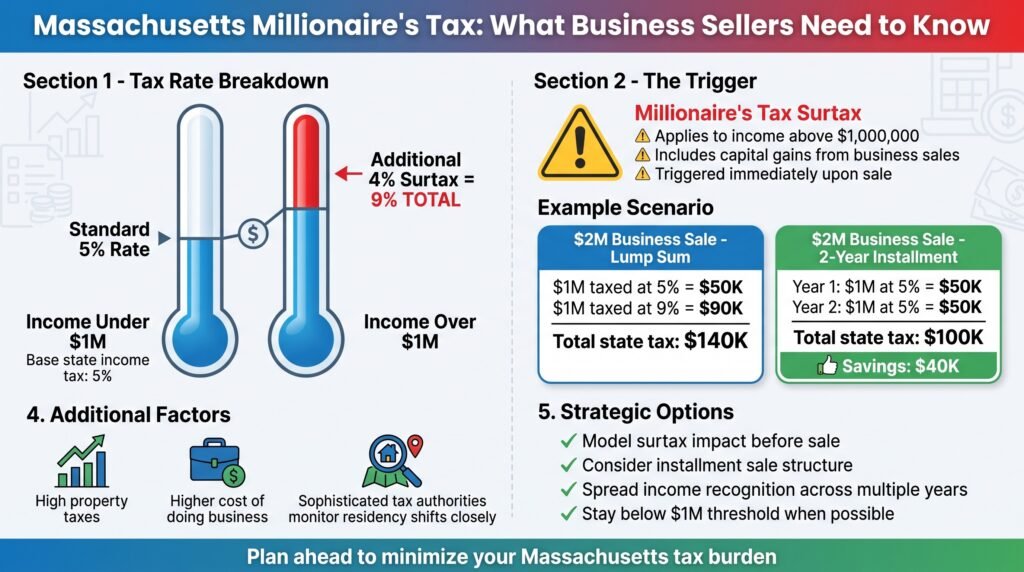
State Income Tax Rate: 5% (recently increased from 4%, with an extra 4% surtax on income over $1 million)
Massachusetts recently introduced a millionaire’s tax that adds an extra 4% surtax on income above one million dollars. That means if your business sale pushes you over that threshold, you’re facing a 9% state tax rate on the excess.
The surtax applies to capital gains, so a successful exit can trigger it immediately.
Massachusetts also has high property taxes and a relatively high cost of doing business, which affects buyer interest and valuation.
The state’s tax authorities are sophisticated and well-funded, so any try to defer income or shift residency will be closely examined. If you’re planning a sale in Massachusetts, model out the surtax impact and explore whether structuring the deal as an installment sale or spreading recognition across many years can keep you under the threshold.
6. Oregon
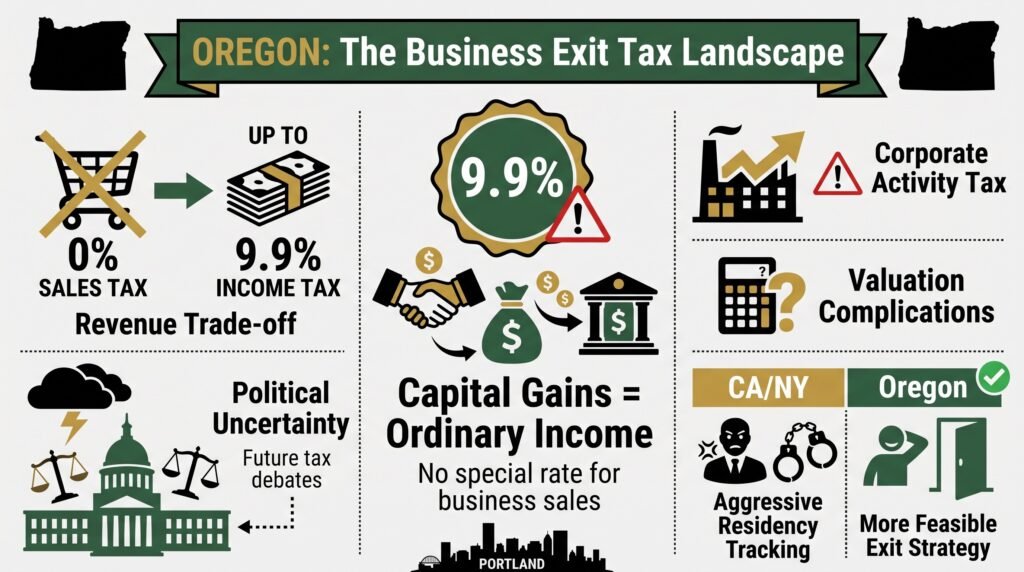
State Income Tax Rate: Up to 9.9% (no sales tax, but high-income tax)
Oregon doesn’t have a sales tax, so the state makes up revenue through high income taxes. Capital gains from business sales are taxed as ordinary income, and the top rate kicks in at relatively modest income levels.
If you’ve built a successful business in Portland or elsewhere in Oregon, you’re facing a near-10% haircut at the state level on your exit.
Oregon also has a corporate activity tax that can complicate valuations if your business exceeds certain revenue thresholds. The state has been debating extra taxes on high earners and businesses, so the political environment adds uncertainty.
One advantage is that Oregon does not aggressively chase former residents the way California or New York does, so a well-planned residency change before a sale may be more feasible.
7. Washington
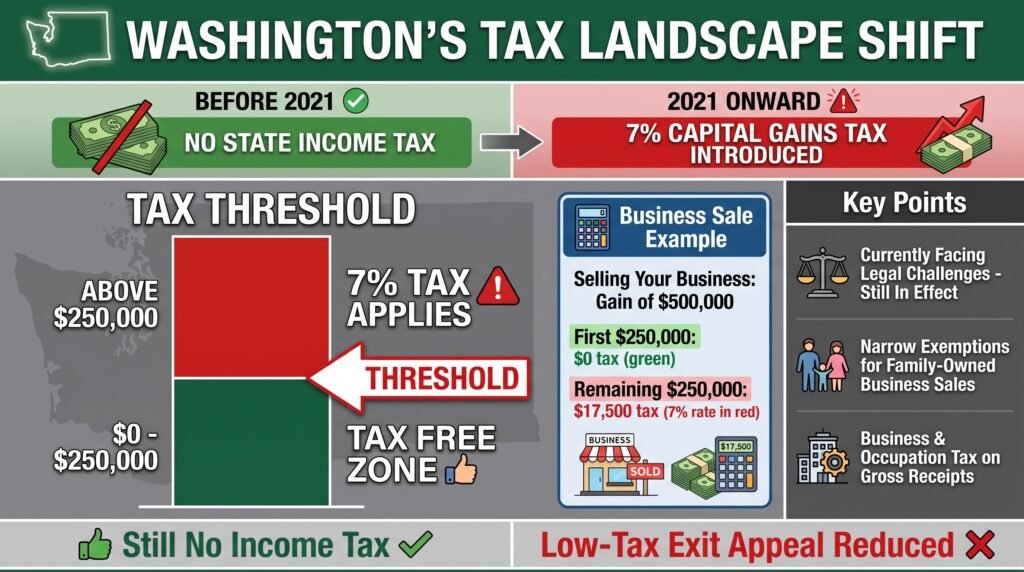
Capital Gains Tax: 7% on gains above $250,000 (relatively new, enacted in 2021)
Washington traditionally had no state income tax, which made it a favorite for business owners. That changed in 2021 when the state introduced a 7% capital gains tax on gains exceeding $250,000.
The tax has faced legal challenges, but as of now it stays in effect.
If you sell your business in Washington, you’ll owe 7% to the state on any gain above the threshold. Certain exemptions exist for sales of family-owned businesses and some real estate, but the rules are narrow and need careful planning to qualify.
Washington also has a business and occupation tax that’s based on gross receipts, which can affect your company’s attractiveness to buyers.
The lack of a traditional income tax is still an advantage for ongoing operations, but the capital gains tax has eliminated much of Washington’s appeal as a low-tax exit state. However, a proposed millionaire’s income tax of 9.9% is being proposed which could soon change the course of business and wealth flight from the state.
Business Seller Sanity Checklist
As we covered in the first part of this series, it’s time for another seller sanity check. Whether you are planning to sell your business solo or utilize the experience and leveraging skills of a broker, pause and review the discussed points, and you have done the basic preparation needed to place your business on the market.
A major contributor to business undervaluations, wasted time, and poor exits is simply a lack of readiness. A broker can only sell what you’ve built.
If your business:
- Depends heavily on you
- Has inconsistent or unclear financials
- Lacks systems or transferable processes
Then even the best broker will struggle to get a premium offer. Brokers don’t create value. They expose it.
Bottom line: If you are not sure what basic preparation is required before considering a business valuation or selecting a business broker, click the link below to take our free business readiness quiz. The score will give you a clear indication of where you are in the process and the next course of action to take to ensure you start the business sale and exit on the right footing.
If your business is valued at $1 to $40 million, an experienced business broker like Earned Exits will leverage more potential buyers and an average increase of profit of 20 to 30% more than going it alone.
The classic adage applies, “If you want to go fast, go alone, If you want to go far, go together” Stated simply, alone is cheaper, but not always most profitable. Our comprehensive review of Earned Exits business brokers here.
The company offers a seller-centric approach that maximizes real value for owners selling businesses valued $1M–$40M+. Click the link below to start Earned Exits’ free valuation process by filling out their short form.
Conclusion: Plan Now, or Pay Later
After reviewing all seven states, the one that stands out as most critical for advance planning is California. The combination of the nation’s highest income tax rate, aggressive enforcement by the Franchise Tax Board, and limited exclusions means California business owners face the steepest hill when they sell.
A $5 million business sale in California can trigger over $650,000 in state taxes alone before considering federal obligations.
That’s money that could fund your retirement, support your family, or launch your next venture.
If you’re anywhere near a business sale in California, New York, New Jersey, Illinois, Massachusetts, Oregon or Washington, your most important move is to start planning now. Not next quarter.
Not when a buyer shows interest. Right now.
The owners who keep the most money are the ones who understand their state’s rules, work with advisors who specialize in exit planning, and structure their deals to minimize tax leakage. That might mean spreading the sale across many tax years through an installment agreement.
It could involve moving some assets into opportunity zones or charitable remainder trusts.
It might need establishing residency in a no-tax state like Florida, Nevada or Texas well before you put the company on the market.
Every one of these strategies needs time. The documents you sign, the places you live, the investments you make all need to be in place and documented before the letter of intent arrives.
Once you’ve shaken hands on a deal, your options shrink dramatically.
Visit the Business Exit Planning State-by-State resource to take a closer look into your specific state. You’ll find tailored guidance, case studies and actionable strategies designed for owners in high-tax environments.
The difference between a well-planned exit and a rushed one isn’t just a few percentage points.
It’s often the difference between financial security and regret. Take the first step today, because the state isn’t going to tell you how to keep your money.
That’s your job.
Frequently Asked Questions
How much can state taxes reduce my business sale proceeds?
State taxes can claim anywhere from 5% to over 13% of your sale price depending on where you operate. In California, a $10 million sale could trigger $1.3 million in state income tax alone.
When you add federal capital gains tax, Medicare surtax and any local taxes, you can easily lose 40% or more of your headline price to taxes.
The exact amount depends on your state, the size of your sale, your other income, and how the deal is structured. Planning ahead with installment sales, tax-deferred exchanges, or residency changes can significantly reduce this burden.
Can I move to a different state before selling to avoid high taxes?
Yes, but it needs genuine relocation and careful timing. States like California and New York aggressively audit taxpayers who claim to have moved before a major sale.
You need to establish true domicile in the new state, which means spending more than half your time there, moving your family, registering to vote, getting a new driver’s license, and creating a clear paper trail.
Most advisors recommend living in the new state for at least a full year before the sale. Simply buying a condo in Nevada and visiting occasionally won’t protect you.
The high-tax state will argue you’re still a resident and assess tax on the full sale price.
What is an installment sale and how does it help?
An installment sale spreads your business sale proceeds across many years instead of receiving everything at closing. The buyer pays you over time, and you only recognize taxable gain as you receive payments.
This can keep you out of the highest tax brackets in states with progressive rates, and it may help you avoid surtaxes that kick in above certain income thresholds.
Installment sales also defer tax liability, giving you more time to plan extra strategies. The downside is you’re taking payment risk from the buyer and you’re still eventually paying tax, just over a longer period.
Are there any exclusions for small business sales?
Federal tax law offers a qualified small business stock exclusion that can eliminate or reduce capital gains on certain C corporation shares held for more than five years, but this is a federal benefit. Most high-tax states do not conform to this exclusion, so you’ll still owe state tax even if you qualify for federal relief.
Some states offer narrow exclusions for specific industries or family business transfers, but the rules are complex and the thresholds are often low.
Don’t assume you’ll qualify for an exclusion without detailed analysis from a tax advisor who specializes in your state.
How does the structure of my business affect taxes when I sell?
Your business entity type has a massive impact on exit taxes. C corporations face double taxation because the company pays corporate tax on gains and you pay personal tax on distributions.
S corporations, LLCs and partnerships generally pass income directly to owners, avoiding the double hit.
But in some states, the entity type changes which taxes apply and at what rates. Asset sales are often taxed differently than stock sales.
If you’re planning an exit, review your entity structure now.
Sometimes converting from a C corp to an S corp or restructuring as an LLC can save significant tax, but those changes need to be made years before a sale to avoid IRS penalties.
What should I look for in an exit planning advisor?
You need someone who specializes in business exits and understands the tax rules in your specific state. Your regular accountant may not have deep experience with exit strategies like charitable remainder trusts, opportunity zone deferrals, or residency planning.
Look for a certified exit planning advisor or a CPA who works primarily with business sales.
Ask how many exits they’ve guided in your state, what the average tax savings was, and whether they work with a team that includes attorneys and financial planners.
The right advisor can save you multiples of their fee in reduced taxes.
Is it ever too late to start planning my business exit?
The earlier you start, the more options you have, but it’s almost never truly too late. If you have a letter of intent on the table, your options are limited but you can still negotiate deal structure, payment terms, and timing to minimize taxes.
If you’re a year or two away from selling, you have room to adjust entity structure, begin residency changes, and explore tax-deferred strategies.
Ideally, you’d start exit planning three to five years before a sale, which gives you time to boost company value, clean-up operations, and apply sophisticated tax strategies.
Even if you’re starting late, get professional guidance immediately.
The difference between doing nothing and doing something is often hundreds of thousands of dollars in your pocket.
Sources and references
- Exit Equity, “How to Sell a Business in Washington State (2026 Guide).”
- Buchalter, “Selling a Washington Business: How Washington’s Capital Gains Excise Tax and the New Millionaires Tax Change Deal Structure.”
- Clark Nuber, “Washington Capital Gains Taxes in Mergers and Acquisitions.”
- Evergreen Small Business, “The Qualified Family-Owned Small Business Deduction.”
- Sound Business Brokers, “Washington Business Sale Tax Implications Guide.”
- CT Acquisitions, Sell Your Business Portland OR: 2026 Owner Guide
- Robert Hall & Associates, Oregon Capital Gains Tax in 2025
- Multnomah County, Buying or Selling a Business
- Stripe, 2026 Oregon Sales Tax Rates and Calculator
- Oregon State Bar Taxation materials on Oregon taxation of nonresident gain from LLC interests
- Percy Law Group, PC. Buying or Selling a Small Business in Massachusetts: What You Need to Know. Published April 30, 2025. Available at: www.percylawgroup.com. Percy Law Group is a Massachusetts-based full-service legal team specializing in business transactions, mergers and acquisitions, and exit planning for small business owners across the Commonwealth.
- Berkshire Money Management. Selling Your Massachusetts Business? 6 Last-Minute Tax Strategies to Keep More of the Sale Proceeds. Available at: berkshiremm.com. This source provided the foundational framework for the six post-LOI tax strategies discussed in this article, including the Deferred Sales Trust, installment sale structures, Opportunity Zone investing, and the mechanics of Massachusetts’ Millionaire’s Surtax as applied to business sale proceeds.
- [1] Illinois Department of Revenue. “Income Tax Regulations.” Available at: https://www.revenue.state.il.us/
- [2] Illinois Small Business Development Center. “Closing Your Business.” Available at: https://www.ilsbdc.biz/
- [3] Internal Revenue Service. “Sale of Business.” IRS Tax Guide for Small Business.
- Available at: https://www.irs.gov/publications/p334
- [4] Illinois Compiled Statutes. “Business Corporation Act.” Available at: https://www.ilga.gov/legislation/ilcs/ilcs.asp
- [5] National Center for Employee Ownership. “ESOP Tax Incentives and Contribution Limits.” Available at: https://www.nceo.org/
- U.S. Small Business Administration, “7 Tax Strategies to Consider When Selling a Business”
- RBC Wealth Management, “Minimize tax and maximize your business sale”
- EP Wealth Advisors, “How to Manage Taxes When Selling a High-Value Business”
- U.S. Bank, “Tax Implications of Selling a Business”
- Exit Planning Institute, “Certified Exit Planning Advisor Resources”
- [1] Nongrantor trust strategies and California sourcing rules
- [2] Charitable Remainder Trust and ESOP tax treatment
- [5] Installment sales and QSBS provisions under IRC
- [6] California residency audit practices and wealth migration patterns
*Disclaimer: This article is written for educational purposes and should not be interpreted as financial advice. We may receive compensation for referrals made through this article.