
For many owners of privately held companies, the biggest tax bill of their lives arrives on the day they sell. Where they are legally resident when it does can be worth millions of dollars, and a growing number of owners are acting on that.

Quick Summary
- The incentive is real. A business sale compresses a lifetime of value into one tax year, so state rates (up to 13.3% in California) can mean seven figures on a large sale.
- Moving works only if the move is real. High-tax states audit recent departures, and income sourced to the old state can stay taxable there.
- Most high earners don’t move for taxes. Research finds small overall effects, but mobile owners and skilled workers respond more, and a sale is when mobility peaks.
- Washington is the live test. It enacted a sizable capital gains tax, and now a 9.9% tax on household income over $1 million (effective 2028). Repeal is on the November 3 ballot.
- Plan early and model everything. Start well before a sale and count property, sales, and estate taxes, not just income tax.
Table of Contents
- Quick Summary
- The Exit That Costs More in Some Zip Codes Than Others
- Where the Pressure Is Being Felt
- Washington Case Study: Companies, Founders, and the Millionaires Tax
- How to Choose the Right Business Broker for Your Exit
- Frequently Asked Questions

The Exit That Costs More in Some Zip Codes Than Others
For most business owners, the company is the largest asset they will ever hold. Decades of long hours, reinvested profits, and personal risk are eventually converted into a single payout, and that payout is taxed.
The federal government takes its share no matter where the seller lives: a top long-term capital gains rate of 20 percent, plus the 3.8 percent net investment income tax in many cases. What differs enormously is what happens next.
A handful of states levy no tax on personal income at all, including Florida, Texas, and Nevada. Others tax capital gains at the same rates as wages, and the top rates are steep. California’s top rate is 13.3 percent.
Minnesota’s is 10.85 percent. New York’s top state rate is lower than California’s, but when New York City’s income tax is layered on, the combined state and local burden for a city resident can approach 15 percent, according to tax guides aimed at business sellers.
The arithmetic is stark. On a $10 million gain, a California resident faces roughly $1.33 million in state tax before the federal bill is even calculated. A resident of Florida or Texas faces none.
Advisory firms that serve business owners, from regional CPA practices to the wealth management arms of major banks, now routinely open sale-planning conversations with a question that has nothing to do with valuation or buyers: where do you plan to live when this closes?
That question is reshaping behavior at the margins, and in some places it is becoming a political talking point. This article looks at why owners are moving, how they are doing it, where the strategy goes wrong, and what the academic evidence says about whether taxes are really driving a broad exodus.
Where the Pressure Is Being Felt
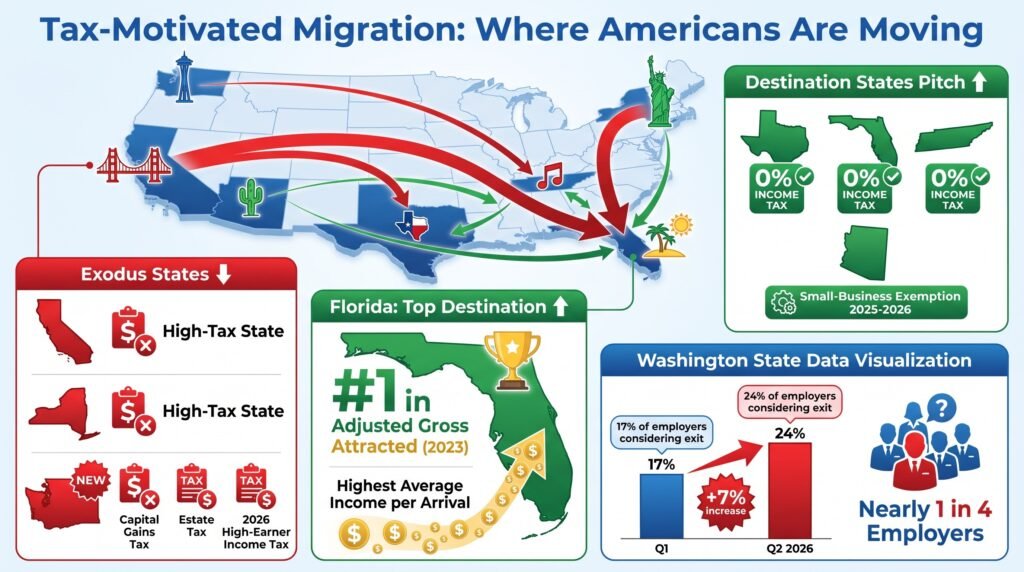
California and New York have been the traditional sources of tax-motivated departures, and Florida has been the most common destination.
One 2026 tax-advisory guide notes that Florida attracted more adjusted gross income from domestic migration in 2023 than any other state, and that incoming residents had the highest average income of any state’s arrivals.
Advisory firms that market to relocating owners cite that kind of data as evidence that high earners are voting with their feet.
The debate has recently moved to states that were not historically seen as high-tax. Washington has no broad personal income tax, but it has added a capital gains excise tax and an estate tax, and in 2026 it enacted a first-of-its-kind income tax on very high earners, covered in the next section.
A spring 2026 survey by the Association of Washington Business found that nearly one in four employers, 24 percent, were actively considering moving out of state, up from 17 percent the prior quarter.
The Washington Policy Center, a think tank that favors lower taxes, argues that high earners and companies leaving will erode the revenue the new taxes are meant to raise. Supporters of the new taxes dispute that framing, and survey intentions are not the same as completed moves, but the numbers show how seriously owners are now weighing the question.
Meanwhile, the destination states are making the pitch. Texas, Florida, Tennessee, and others advertise their lack of an income tax.
Smaller incentives matter too. Arizona, for instance, has indexed a small-business exemption for the 2025-2026 cycle, a detail promoted by firms that help companies relocate.

Washington Case Study: Companies, Founders, and the Millionaires Tax
No state has drawn more attention to this issue in 2026 than Washington, a state long marketed on its lack of an income tax.
On March 30, Gov. Bob Ferguson signed a law imposing a 9.9 percent tax on household income above $1 million, effective January 1, 2028, with first payments due in 2029, according to Axios and tax-law trackers.
The same law includes sales-tax exemptions on items such as diapers and over-the-counter medicine and an expanded small-business B&O tax break, which supporters say help working families.
It arrives on top of a 2025 estate tax with a top rate of 35 percent and a capital gains excise tax of 7 percent on the first $1 million of gain and 9.9 percent above that, which the same trackers say stays in force either way.
The fight is not over. Initiative 645, on the ballot this Tuesday, November 3, would repeal the tax and bar state and local taxes on personal income.
Axios notes that Washington voters have rejected income tax proposals ten times since 1934. For owners planning an exit, the vote matters: a sale in 2028 or later would face the new tax unless repeal passes, while an earlier sale would not.
What the numbers show, and what they don’t
Advocacy groups on the repeal side point to surveys. The Washington Policy Center cites an Association of Washington Business survey this spring in which 24 percent of employers were considering leaving, up from 17 percent the prior quarter.
Another summary of AWB polling, in a Heritage Foundation commentary, puts the share of business leaders considering a departure at 44 percent. The figures differ, probably because the questions differ, and in both cases they measure intentions rather than completed moves.
A repeal supporter’s op-ed also says Washington ranks sixth in the nation for losing higher-income residents, while the Boston Globe reports the state ranked sixth in total residents gained last year. Both can be true, and neither settles whether the tax will cause a lasting exodus.
Supporters of the tax dispute the framing. Seattle Mayor Katie Wilson has called the concerns overblown.
Senate Majority Leader Jamie Pedersen, the tax’s lead sponsor, argues the tax would not put Washington out of line with the roughly 41 other states that tax income and that the state’s tax edge over California and Oregon had already faded. He has also acknowledged that the 2025 estate tax nudged some wealthy residents toward the exit.
For business owners, the takeaway is timing. Because the tax does not take effect until 2028, nearly every move so far has been anticipatory, and owners with a sale on the horizon are weighing residency changes against a ballot result that arrives days from now.
The lessons from earlier sections apply here as well: a credible move needs real changes to where a person lives and works, and a state that is losing taxpayers is likely to look closely at anyone leaving.
Learn more about why the business in the moment that matters, the residency trap, and much more in this article here.

How to Choose the Right Business Broker for Your Exit
Matching Broker Expertise to Your Business Size ($1M-$40M)
Business size represents a crucial matching factor when selecting an appropriate broker representation.
Small businesses valued under $1 million typically require different marketing approaches and buyer networks than mid-market companies valued between $5-40 million. The most effective brokers specialize within specific valuation ranges rather than attempting to serve all market segments equally.

Earned Exits has developed particular expertise with businesses valued between $1-50+ million, with specific methodologies tailored to different valuation segments within this range.
Their approach recognizes that a $2 million service business requires different positioning and buyer targeting strategies than a $30 million manufacturing operation, even while applying consistent transactional excellence principles across all engagements.
Earned Exits has facilitated over 47 successful business transactions worth $2.1 billion, demonstrating how specialized industry knowledge translates to exceptional results.
While many brokers operate as generalists, Earned Exits has developed specialized expertise across 17 distinct business sectors, including manufacturing, distribution, professional services, technology, and specialty contracting.
This preparation phase frequently generates the highest return on investment in the entire exit process, with strategic improvements often increasing final transaction values by 20-50% when implemented 12-24 months before planned exits. Start the process of your business exit today with Earned Exits free business valuation by clicking the button below:



Earned Exits Testimonials


Frequently Asked Questions
These common questions address the concerns most business owners face when contemplating their exit strategy. While each situation presents unique considerations, these general guidelines provide starting points for your exit planning discussions.
Can I avoid state tax by moving right before I sell?
Usually not. States scrutinize last-minute moves, and your new home must be a genuine change in where you live and work. Moving well ahead of a sale is more credible.
Does leaving a state end all its taxes on my business?
No. A state can still tax income sourced within its borders, such as gains tied to assets or real estate located there, especially in asset sales.
Are people really leaving high-tax states over taxes?
Some are, but the evidence for mass flight is thin. Studies find modest aggregate effects, with larger responses among highly mobile owners and skilled workers.
Is Washington taxing income now?
Not yet. The 9.9% tax on household income above $1 million is set for January 1, 2028, and voters decide on repeal (Initiative 645) on November 3, 2026. Washington’s capital gains excise tax applies either way.
Is a no-income-tax state always cheaper
Sometimes. Property, sales, franchise, and estate taxes can offset the savings, and lifestyle factors often matter as much.

*Disclaimer: This article is written for educational purposes and should not be interpreted as financial advice.
*Disclaimer: This article is written for educational purposes and should not be interpreted as financial advice. We may receive compensation for referrals made through this article.